The Age of the Imperium


Article Index
The first edition of the Warhammer 40,000 tabletop game and how it changed over six years.
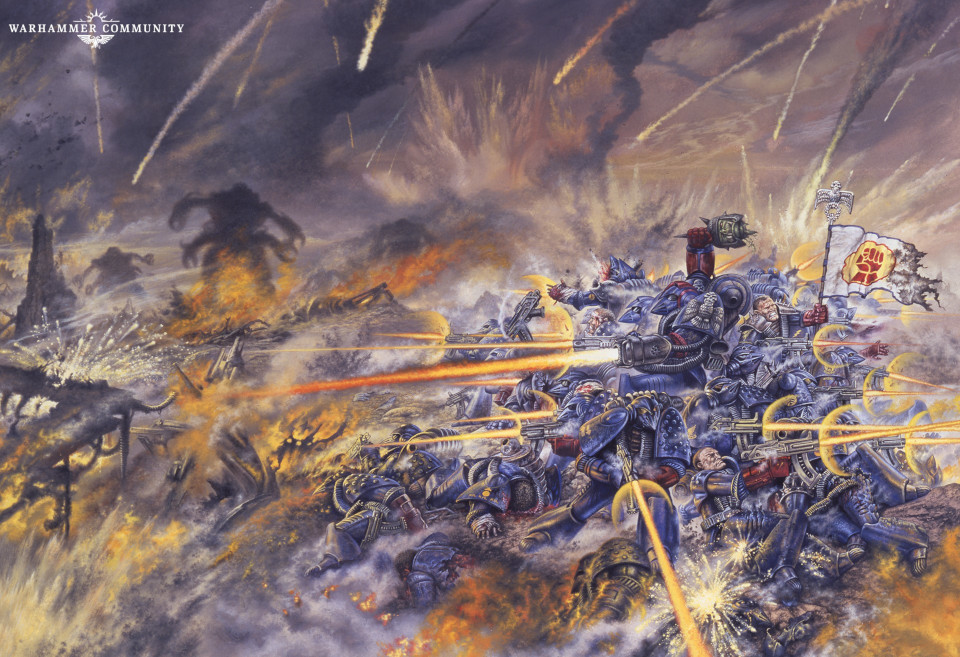
I didn't play that many games of Rogue Trader. I mostly played 2nd edition with a smattering of 3rd. Still, I have fond memories of Rogue Trader.
Beware of Greeks bearing particle beam weapons
Rogue Trader was released in 1987. Development of the game was far from smooth. It was written three times. I intend to write about Rogue Trader's many precursors.
The Rogue Trader Rulebook
For more than a hundred centuries the Emperor has sat immobile on the Golden Throne of Earth. He is the Master of Mankind by the will of the gods and master of of a million worlds by the might of his inexhaustible armies. He is a rotting carcass writhing invisibly in power from the Dark Age of Technology. He is the Carrion Lord of the Imperium to whom a thousand souls are sacrificed every day, and for whom blood is drunk and flesh is eaten. Human blood and human flesh - the stuff of which the Imperium is made.
To be a man in such times is to be one amongst untold billions. It is to live in the cruelest and most bloody regime imaginable. This is the tale of these times. It is a universe you can live today if you dare - for this is a dark and terrible era where you will find little comfort or hope. If you want to take part in the adventure then prepare yourself now. Forget the power of technology, science and common humanity. Forget the promise of progress and understanding, for there is no peace amongst the stars, only an eternity of carnage and slaughter and the laughter of thirsting gods.
But the universe is a big place and, whatever happens, you will not be missed ...
-Warhammer 40,000: Rogue Trader
Rogue Trader was sold as a 288 page book. You had to source miniatures and other paraphernalia separately.
As a rules set I think the core game holds up. The I-go-you-go turn sequence will be familiar to modern players. Rules were initially geared towards narrative skirmish games with two players run by a games master.
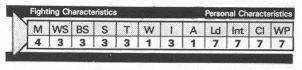
This edition of 40K had four separate personal characteristics. Leadership was used in rout tests. Intelligence dictated the tech level of equipment a model could use. Cool tests were made to determine psychology effects like fear or hatred. Will Power was used to defend against psychic attack. Personal characteristics would be rolled into a single Ld stat in later rules.
One thing modern players might notice is how slowly infantry move. A typical move distance is 4 inches. Squats (Space Dwarves) move 3 inches! Models with heavy weapons or armour could have movement penalties for encumbrance and terrain could reduce movement further. There was a "reserve move" for troops that didn't attack that turn and were sufficiently far from the enemy so it wasn't as crippling as it might sound.
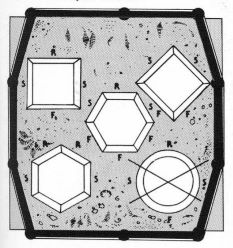
Psychic powers, weapons, armour and equipment were generic across all factions. Major factions included profiles for troops and three hero types. These would include percentages for arms and equipment generation at squad level.
The vehicle rules were too detailed for my liking but vehicles were a rarity anyway. Vehicles deserve a dedicated article.
Equipment
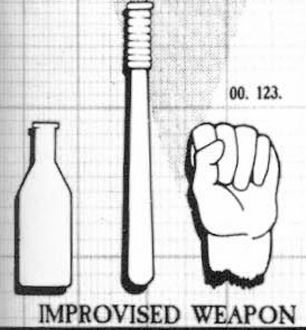
Rogue Trader had a plethora of weapons, high-tech and primitive. The inclusion of bows, blades and black-powder weapons meant that Warhammer (Fantasy) miniatures could be used as-is.
Weapons could have close-combat, movement penalty, move-or-fire, following-fire or area affect characteristics. Some had special rules. Plasma Guns needed to be energised for two turns before firing, for example.
Immobilising weapons could be annoying. Models could not do anything else while under their effects. Unit coherency rules meant they could immobilise whole units. Models hit by Flamers had to test if the fire went out every turn. Web Guns would make models physically helpless and kill low intelligence creatures outright.
Warp Space, Warp Drives, Warp Gates, Warp Portals, Warp Creatures & Warp Storms
The Age of the Imperium section included lore and profiles for the inhabitants of the 40K universe. The Imperium made up the bulk, covering Space Marines, the Imperial Army, Assassins, Abhumans and various character types. Eldar pirates/mercenaries, Orks and prototypical Tyranids are present. The Ancient Slann - Space Frogs - have their only 40K rules. Despite Realms of Chaos being advertised at least as far back as 1983 ↗ Chaos wasn't described in the book but there are a few pages of Warp Creatures and a section on generating mutants. About ten pages are dedicated to dangerous flora and fauna including Genestealers and a killer flannel.
There were no army lists in the rulebook. The example Battle at the Farm scenario had fixed factions, force sizes, equipment and battlefield. The players had to use the forces assigned by the games master and achieve narrative driven victory conditions. There were points values but the book made no pretence about them being balanced.
A Breed Apart
Military service as a warrior of the Imperium is a common sentence for minor criminals. Their offences might include filling out tax returns incorrectly (wilful fraud, however, is a capital offence), overdue library books, failure to maintain drains, littering, etc.
-Warhammer 40,000: Rogue Trader
The tone and structure of the rulebook is different from almost everything that followed in White Dwarf and the various supplements. The book is also full of mistakes and ambiguities. Using the rulebook alone requires participants to exercise their judgement and bring a sense of fair play.
40K's sci-fi precursors were often miniature-based combat supplements for third party role-playing games. This book is a mix of the two genres.
Beyond the Rulebook
The rules were constantly augmented or replaced, not always for the better. In a time before the internet you had to somehow acquire this stuff on paper. Our group never had a complete set rules for this edition of 40K. Money for rules competed with money for miniatures after all.
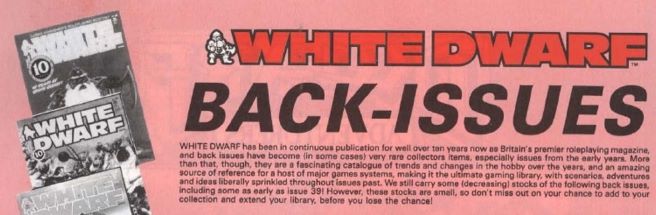
New miniatures and their rules would appear in White Dwarf magazine on an ad hoc basis ↗ . These would sometimes be reprinted in collections. Orks and Chaos got their own books.
Rules Revisions & Complexity
WH40K was designed as an adaptable game which could accommodate new systems where necessary. An alternative system for area fire is as follows.
-Rick Priestley, White Dwarf 99
Priestley was unhappy with the rules in the rulebook for area effect weapons and revised them almost immediately. They were replaced again in the Battle Manual.
Vehicle rules were revised in WD103 and replaced completely in WD128.
Rules were often overly detailed with the time spent resolving them outweighing their impact. Medic rules (WD102) added a D100 table of wounds and their in-battle effects. Robot rules (WD104) added computer programs and an entire turn phase. Orks became notorious for their crazy rules.
Close combat was revised (WD150) to be more decisive. This was mostly for the good but the parry rule made swords disproportionately effective.
Warhammer was never a game of chess but a Rogue Trader game might be more about entertaining dice outcomes than a competition between two players, depending on the rules in play.
Choose Your Rules
To play Rogue Trader players must select from the available rules, not expect the game to dictate what must be done. Problems can be papered over. Mutually agreed house rules are essential. I read about more rules than I ever used.
I have categorised what I feel are the major milestones of the Rogue Trader system.
Rulebook Release (1987)
For example. A fight has broken out at Greasy Kim's Bar and Diner where a group of asteroid miners are having a little trouble with a freighter crew. The bar is packed, but most of the other customers have made a break for it, leaving only a half-dozen solo-truckers, drunken salesmen and bar staff. The following models are involved: the miners (4 players with 1 character each), the freighter crew (4 players with 1 character each), and the bystanders (6 characters all played by the GM).
-Multi-sided Games, Rogue Trader
War game with heavy role-playing influences. Everything, including personality profiles, can be randomly generated. There are 9 pages of vague narrative descriptions for games masters to draw scenarios from.
The First Army Lists (1987)
The example scenarios defined fixed forces, which is a reasonable thing for a games master to do to create a balanced game. The first scenario was included in the rulebook and a couple more followed.
The first army list, for the Dark Angel's Ravenswing, was published in White Dwarf 96. It was exclusively jetbikes. A few mostly forgettable Space Marine army lists followed. The Book of the Astronomicon included army lists for Space Marines, Imperial Army, Rogue Traders, Pirates, Orks, and Eldar. If you like finely crafting an army you won't find much joy here. Lists define fixed squad sizes, equipment and mandatory units.
The early army lists were so bad Bryan Ansell ↗ forbade any reprints. However, The Book of the Astronomicon and White Dwarf 97 remain a useful source of special characters.
The 2nd Tranche of Army Lists (1988)
White Dwarf 105 heralded the arrival of army lists that gave players more agency in constructing their forces. These reflected an expanded and well-defined model range.
WD105 included army lists for Space Marines and Eldar Harlequins. Randomness remained a part of list building.
Revised Vehicles (1990)
White Dwarf 128 introduced new vehicle rules. Movement was simplified. Everything else got more complicated with diagrams and twenty-seven eight-by-ten colour glossy photographs with circles and arrows and a paragraph on the back of each one explaining what each one was to be used as evidence against us ↗ . And that's without the Ork malfunction and repair cards. The target diagrams largely restricted players to vehicles manufactured by Games Workshop.
I intend to author a separate article about Rogue Trader vehicles.
Prelude to Second Edition (1992)
White Dwarf 150 made significant revisions to close combat, many of which were carried into 2nd edition. The Battle Manual is pretty close to the 2nd edition shooting rules.
The Space Wolves army list in White Dwarf 157 eliminated random rolls for forces and equipment. It formed the template for 2nd edition's Codex Space Wolves.
If you incorporate all these rules into the game you might consider playing 2nd edition instead.
Army Lists

Below is a table of books containing the last published army lists for major factions in the Rogue Trader era.
| Faction | Supplement |
|---|---|
| Space Marines | Compendium; Compilation |
| Imperial Guard | Compendium |
| Squats | Compendium |
| Eldar Harlequins | Compendium |
| Orks | 'Ere We Go; Freebooterz |
| Chaos | Realm of Chaos; Slaves to Darkness; Compilation |
| Craftworld Eldar | Compilation |
| Genestealers | Compilation |
| Tyranids | White Dwarf 145 |
The table is far from comprehensive.
I intend to author more detailed articles on some of these factions.
Other Supplements
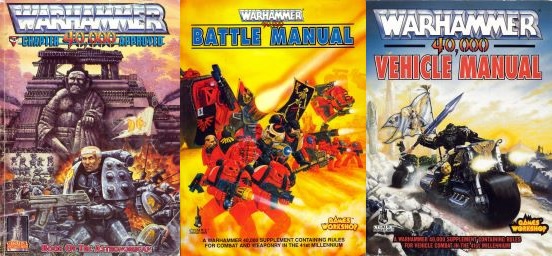
If you want something more esoteric like pirates see the pithily titled Warhammer 40,000 Chapter Approved The Book of the Astronomican.
Warhammer Siege included Siege Dreadnoughts in addition to siege rules.
The 1992 Warhammer 40,000 Battle Manual consolidated all the new weapon rules. The Warhammer 40,000 Vehicle Manual did the same for vehicles.
The Oldhammer White Dwarf Index ↗ or Hive World Terra ↗ sites are good places to track down anything exclusive to White Dwarf.
An Example Unit Choice
Army lists often combined dice roll restrictions, compulsory choices and requirements to take one unit before you could take another.
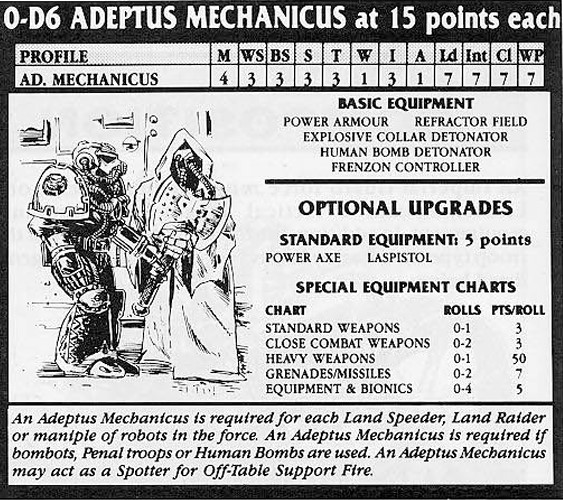
Imperial Guard players could have 0-D6 15 point Adeptus Mechanicus tech priests. Their absence prohibited at least four other units. Every vehicle required one. Bad luck if you have two vehicles and rolled a 1! You had to pay points to roll on a chart for optional weapons.
Everyone I knew bought and painted models we liked the look of first and maybe worked them into an army afterwards. The army lists exceeded our purchasing power so restrictions were routinely ignored or proxy models were used instead. Early articles encouraged proxying.
Availability
The Rogue Trader rulebook is still in print. It is advertised on the Warhammer World Store ↗ website along with the Realm of Chaos books as an in-store exclusive. I've never been and can't comment on stock availability.
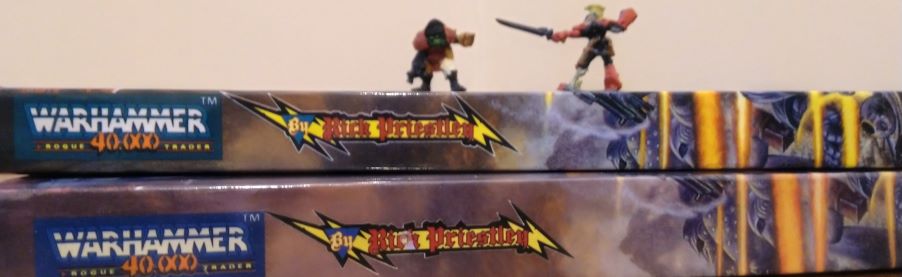
White Dwarf published rules errata. Some of these fixes were included in the paperback version of the rulebook.