Beakies


Article Index
- The First Citadel Space Marines
- In Search of an Army List
- The Raven Wing (1987)
- Index Astartes
- Whitescars (1988)
- Codex Imperialis (1988)
- Grey Knights (1988)
- Terminators (1989)
- Space Marine Army List (1989)
- Armour Marks (1990)
- The Road to 2nd Edition
Space Marines in the first edition of the tabletop war game Warhammer 40,000: Rogue Trader.
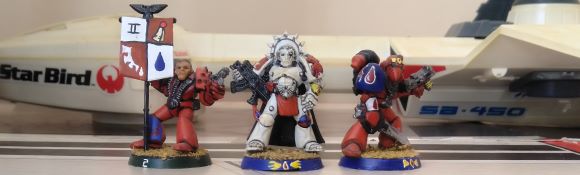
The standard-bearer was sculpted to hang off a Rhino ↗ , not that I knew that when I bought him. The banner might have been cut from a plastic model car bonnet which gave it a pleasing curve & point at the bottom. I think I painted the captain with a Humbrol ↗ white oil-based paint. The bare head was also oil based. Pretty sure the yellows on the miniatures are enamel paint which was good for shininess and opacity. Most other colours are Citadel paints & inks.
If memory serves the flock is green sawdust from a model railway shop. The bases are colour coded as a form of unit identity and have a marker to indicate front facing. The banner bearer is lacking a backpack for the usual reasons.
The First Citadel Space Marines
Bob Naismith sculpted the original LE02 ↗ model. This was the prototype for the initial Imperial Space Marines ↗ that predated Rogue Trader and the base design for the RTB01 ↗ plastic boxed set though modifications were made to accommodate the limitations of plastic injection moulding. Later metal sculpts would be based on the plastic design.
Armour Variants
Contemporary with the initial Space Marine armour design were a number of armour variants. The Limited Edition ↗
series included LE10, also sculpted by Naismith. Mark Copplestone's Death Eagles ↗
may have been an inspiration for what would become Mark 7 armour. Naismith has shown off some of his unreleased greens ↗
that look very similar.
In Search of an Army List
As the most popular range it's unsurprising that Space Marines had lots of rules. These were mostly provided via White Dwarf magazine. The Dark Angels were the first chapter to get their own rules.
The Raven Wing (1987)
The release of Naismith's Jet Cycle miniature ↗ prompted the invention of the Raven Wing seventh company of the Dark Angels chapter led by Captain Gaius Oblonsky. The Raven Wing was described as a specialized company mounted exclusively on MK14 Bullock Jet Cycles.
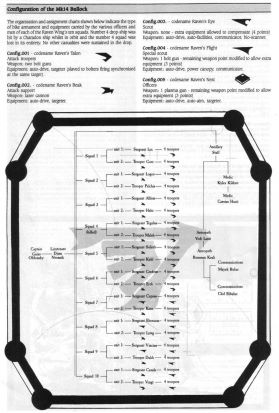
History. The Raven Wing's exact origins are lost in the history of the First Crusade (circa thirtieth millennia - about ten thousand years ago). Indeed little is known of the Dark Angels during that time. The Chapter's early history was removed from all Imperial records following the Horus Heresy and the banishment of the nine "treacher-legions" to the Eye of Terror. The reason for the erasure is known only by the Emperor himself.
According to legends, the Chapter was founded by Lynol Jacobsen or Jonsen, a man whose reputed exploits include the incineration of Goyas Asteroid and the first sub-light circumnavigation of the Outer Dolmans. He is said to have died defending the honour of the chapter in a duel with Leman Russ (founder of the Spacewolves). This may be true, but it is more likely that the story was invented following the inter-legionary wars in the thirty-second millennia.
-Rick Priestley, White Dwarf 96
I believe this is the first mention of the Horus Heresy. The treacher ↗ -legions would have to wait for the Realm of Chaos books for rules and background.
WD96 also had an advert for the Christmas Marines ↗
. Sadly, they never received rules.
Index Astartes
INTRODUCING A NEW FEATURE FOR WARHAMMER 40,000 - INDEX ASTARTES! EVERY MONTH WE'LL BE LOOKING IN DEPTH AT ONE OF THE THOUSAND OF CHAPTERS OF SPACE MARINES. THIS MONTH WE START WITH THE ULTRAMARINES. ONE DOWN ... NINE HUNDRED AND NINETY NINE TO GO!
-David Wise & Rick Priestley, White Dwarf 97
Well, that's one way to fill a magazine. They quickly gave up.
| Chapter | Issue |
|---|---|
| Ultra-Marines | WD97 |
| The Mentor Legion | WD98 |
| Legion of the Damned | WD99 |
Maybe they realised that this approach wouldn't work in the face of a rapidly expanding model range. Maybe it was that the rules after the first issue were underwhelming.
Ultramarines (1988)
White Dwarf 97 presents an army list replete with special characters and a description of the make-up of a chapter.
The issue is undecided on how to spell the chapter name. Ultra-Marines? Ultramarines? Ultra Marines? Did they did they just hand a D6 to the type-setters?
Chapter Ultra-Marine of the Legiones Astartes was founded during the inter-legionary wars of the thirty-second millennium. Tradition places the date at 4001001.M32 - the very first day of the millennium. The chapter is therefore over eight thousand years old, making it a chapter of the third founding. Upon its inception, the Emperor gave the chapter the number
13- formerly the number of one of the treacher-legions now banished to the Eye of Terror 'without name or number and name with all honours erased'.
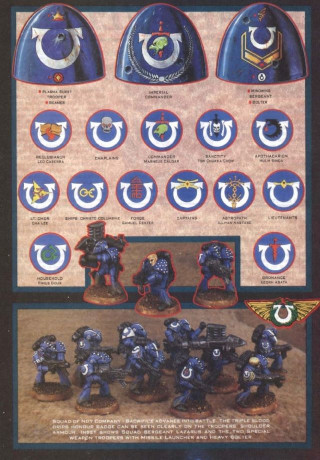
Ultramarine Squads
Every unit is ten strong and has fixed equipment.
| Squad | Cognomen | Notable Equipment |
|---|---|---|
| Special Assault Squad | Scalpers | Cameleoline, two bolt pistols & chainsword |
| Assault Squad | Hunters | Bolt pistol & chainsword except for the graviton gun & flamer guys who also got shuriken catapults |
| Heavy Weapon Squad | Crushers | 1 each of missile launcher, grenade launcher, las-cannon & heavy bolter |
| Tactical Squad | Flayers | The two special weapons guys get a missile launcher & heavy bolter |
| Recon Squad | Stalkers | Cameleoline, bolters & jump packs |
Cameleoline made models harder to hit. The Special Assault Squad was basically a veteran squad. The list also had a bunch of generic vehicles from the rulebook.
Lists in this period often specified two identical pistols, which was weird.
During the shooting part of his turn a player may shoot once with any appropriately armed model. Alternatively, a model may be assumed to throw a hand-held projectile, such as a grenade.
-Rick Priestley, Rogue Trader
The rules imply that a model can only shoot once. Granted, pistols were close combat weapons and a second added an extra attack but that's redundant if you also have a chainsword. Psychic powers like Jinx could disable weapons but that seems very situational. Maybe the designers just liked models with two pistols because it looked cool.
Ultramarine Characters
Several generic officer types are presented - Communications Officers, Librarians, Lieutenants, Captains, Chaplains and Medics. For some reason there were four different ranks of Medic. All the Captains were subject to frenzy which could force them to charge at any enemies within 15" on a failed Cool test.
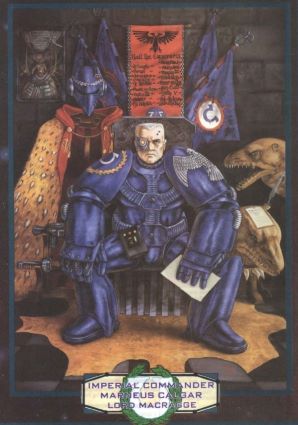
The army list includes ten "Famous Characters" though they didn't have dedicated models. Imperial Commander ↗ Marneus Calgar (who doesn't take to the field anymore according to the text) is the longest serving special character in the game.
There were a few oddball characters. Chief Librarian Astropath Illiyan Nastase was a half-eldar born on Badab. He previously served with the Dark Angels. Master of the Ships Christo Columbine was a Navigator who sold himself into slavery to the Ultra-Marines after bankruptcy.
The Mentor Legion (1988)
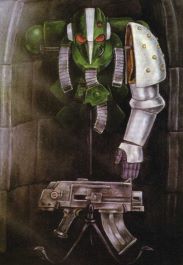
The Mentor Legion were (in rule terms) a short-lived faction. Squads had Champion or Minor Hero profiles and carried more powerful bolt guns. They had unique Targeting Web, Timewarper and Shift Field technology. The rules have a distinct Mary Sue ↗
feel to them. Each squad was five Space Marines at around 400pts. In contrast, an Ultramarines assault squad got you ten Space Marines at under 200pts.
Timewarper
D6 roll Timewarper Function 1 The dilation has no effect. 2-3 Models are allowed to move 2x their normal move allowance. 4-5 Models are allowed to move 3x their normal move allowance. 6 Models are allowed to move 4x their normal move allowance.
In lore terms the Mentors field tested experimental technology which seems at odds with the ossified Imperium of Man. The article credits the original chapter design to Bryan Ansell with development by Alan Merrit and Paul Cockburn.
Legion of the Damned (1988)
White Dwarf 99 had a Renegade Space Marine on the cover and contained a preview from Realms of Chaos with a few paragraphs on the Treacher Legions, Warmaster Horus and the Eye of Terror. The corrupting influence of Chaos had arrived.
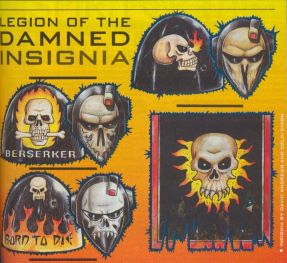
The issue also included rules for the Legion of the Damned, a loyal Space Marine force mutated and maddened by the warp. Like the Mentors this was another elite force of super-powered Space Marines. The rules weren't great - the entire force had to fight as a single unit. Rick Priestley even notes he expects they'll be overpowering or lacklustre depending on the opposing force. But they looked cool and had an interesting background which led to rules in future editions and a dedicated model range ↗ .
The Badab War (1988)
In
901.M41, as a result of Lufgt Huron's apparent mental destabilisation, the Master of the Tiger Claws and Lord of Badab attacked and destroyed an Imperial investigation fleet as it entered orbit around Badab.
White Dwarf 101 included a pure lore article that served as a justification for Space Marines to fight Space Marines. Multiple newly invented chapters were included on both sides along with some adventurous paint schemes illustrated by Gary Chalk.
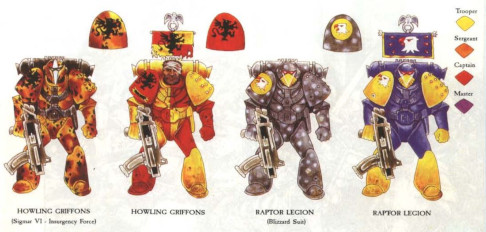
The Fire Hawks, Mantis Warriors, Executioners, Red Scorpions, Minotaurs, Novamarines, Exorcists, Fire Angels, Salamanders, Tiger Claws, Marines Errant, Lamenters, Howling Griffons, Raptor Legion, Space Sharks and Sons of Medusa all got a day in the sun. The Star Phantoms were mentioned but did not get a paint scheme until decades later. It was pedestrian ↗ compared to Chalk's work.
The Eldritch Epistles blog ↗ has a post on early Space Marine livery ↗ .
Whitescars (1988)
Around the same time Warhammer 40,000: Chapter Approved - The Book of the Astronomicon was published. This included a Whitescars army list intended to be representative of Space Marine chapters in general. Lists remained pretty inflexible.
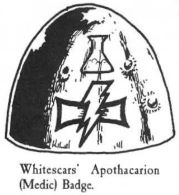
Some of the iconography in this book was cool. Some less so. Using an Erlenmeyer flask as the symbol of an apothecary fell into the latter category. Artists reverted to the caduceus ↗ .
Space Marines were also present in the Valerius Barodin Rogue Trader army list. A separate fixed force of Space Wolves were described for a GM-driven scenario, The Wolf Time.
Codex Imperialis (1988)
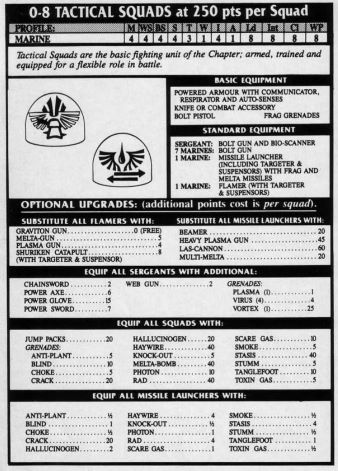
White Dwarf 105 saw the release of a generic Space Marine army list called Codex Imperialis, not to be confused with other publications of the same name. This list is less prescriptive than those that came before with units getting more war-gear options. Techmarines were introduced in this list.
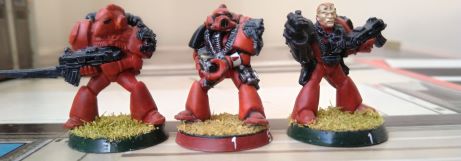
Grey Knights (1988)
Grey Knights were included in an Ordo Malleus army list at the back of Warhammer Realms of Chaos - Slaves to Darkness. Besides being immune to fear from Chaos units the Space Marines are largely the same as those presented in White Dwarf 105. The list also includes Inquisitor, Adeptus Arbite and Imperial Guard units.
The iconic Grey Knight Terminators ↗ hadn't been released yet and would not appear until White Dwarf 114.
Terminators (1989)
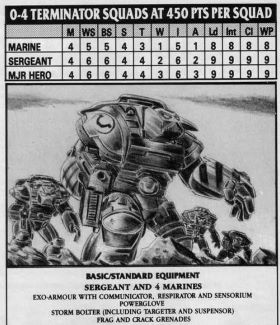
Terminators got their first rules in White Dwarf 109 though these were quickly superseded in White Dwarf 112 with the release of the RTB9 Terminator Squad ↗
box. WD114 introduced the Cyclone Missile Launcher. Close combat Terminators followed in WD115.
Space Marine Army List (1989)
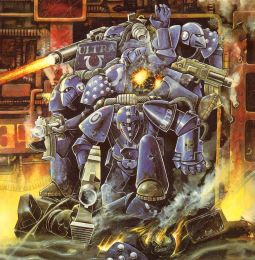
White Dwarf Presents The Warhammer 40,000 Compendium rounded up a bunch of 40K articles from various White Dwarf issues. Space Marines got the Codex Imperialis list with Terminators tacked on the end.
This finally looks something like the core Space Marine force composition that would remain familiar for the next couple of decades. Tactical, assault, devastator, terminator squads & a familiar set of officer ranks.
Armour Marks (1990)
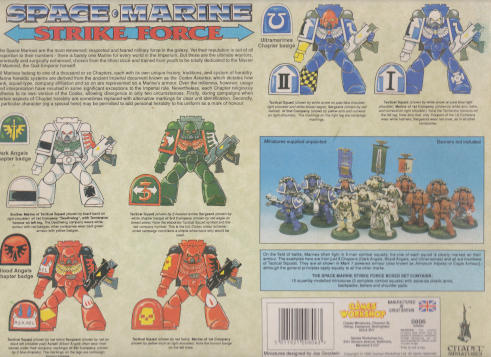
Beaked power armour stopped being the main design when the RTB15 Space Marine Strike Force ↗ box set came out.
The
-Rick Priestley, White Dwarf 1297basic marks of Space Marine armour were all developed up to and during the period of the Horus Heresy.
Jes Goodwin designed seven marks of power armour and beaked armour retroactively became Mark 6 Corvus Armour. Mark 7 Eagle Armour helmets were designed to look more aggressive giving the impression of an angry maw and frowning brow. The five historical marks all got models which was pretty cool. There were also a Mark 8 and various Artificer Armour ↗
designs. New Mark 6 models or helmets would occasionally appear in the range but their heyday was over.
With two smooth shoulder pads, a chest eagle and knee pads Mark 7 armour offered more unique components to paint. This aided the introduction of more detailed heraldry.
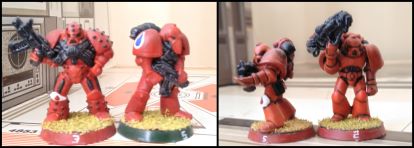
Toughness 4
In the Rogue Trader rulebook Space Marines had Toughness 3. In the face of newer enemies with lots of special rules they weren't quite the elite force they were supposed to be. White Dwarf 129 aimed to fix that.
Space Marines became tougher and were subject to unique rout rules. Space Marine power armour conferred a close combat bonus and ignored penalties for carrying heavy weapons.
For context, Power Armour conferred a 4+ save in Rogue Trader. Most of the Eldar Aspect Warriors had equal or superior armour.
The Road to 2nd Edition
40K evolved a lot during the Rogue Trader era with significant rule changes. 1992 saw a significant shift towards the 2nd edition aesthetic, and it was especially evident with the Space Marines. Many of the 'Eavy Metal miniatures from this time would also feature in 2nd edition codexes.
Space Wolves Army List (1992)
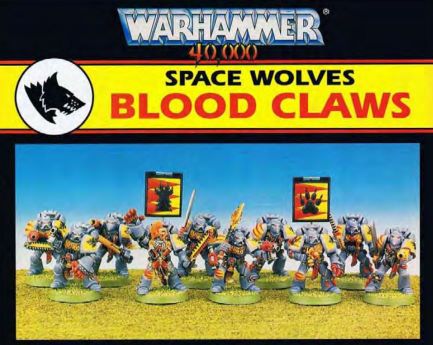
Dedicated Space Wolves miniatures were released with rules. White Dwarf 156 included rules for Ragnar Blackmane and Ulrik the Slayer. White Dwarf 157 added an army list that introduced Blood Claws, Wolf Guards and so on. Njal Storm Caller was added in White Dwarf 158.
Space Marine Scouts (1993)
Despite being around since 1989 ↗
Space Marine Scouts didn't receive rules for 40K until they were included in the Space Wolves list. Scouts were weaker Space Marines with unique unit coherency and infiltration rules. White Dwarf 159 added rules that could be included in any Space Marine, Imperial Guard or Squat lists.
Deathwing Terminators (1993)
White Dwarf 161 added Terminators of the Dark Angels chapter. At the rump end of Rogue Trader this was really there to promote the new Deathwing miniatures though the article did fiddle with teleporter rules and points costs.