The Shadow in the Warp


Article Index
The Advanced Space Crusade board game helped put Tyranids onto Warhammer 40,000 battlefields.
In 1990 Games Workshop released the Space Crusade ↗
board game with Milton Bradley ↗
. Simultaneously Games Workshop released Advanced Space Crusade ↗
, a complex D12 based two player war game superficially similar to Space Hulk ↗
based around what had, until then, been a minor faction.
Tyranids were present in the original Warhammer 40,000: Rogue Trader rulebook but until the launch of this game didn't have much commercial support. If nothing else, this game helped launch Tyranids as a major faction ↗ .
The Narrative
Planet-devouring Tyranids of Hive Fleet Kraken have invaded from intergalactic space to threaten the Imperium of Man. Space Marines must board and sabotage Tyranid hive-ships before their occupants fully rouse from their slumber.
Tyranids
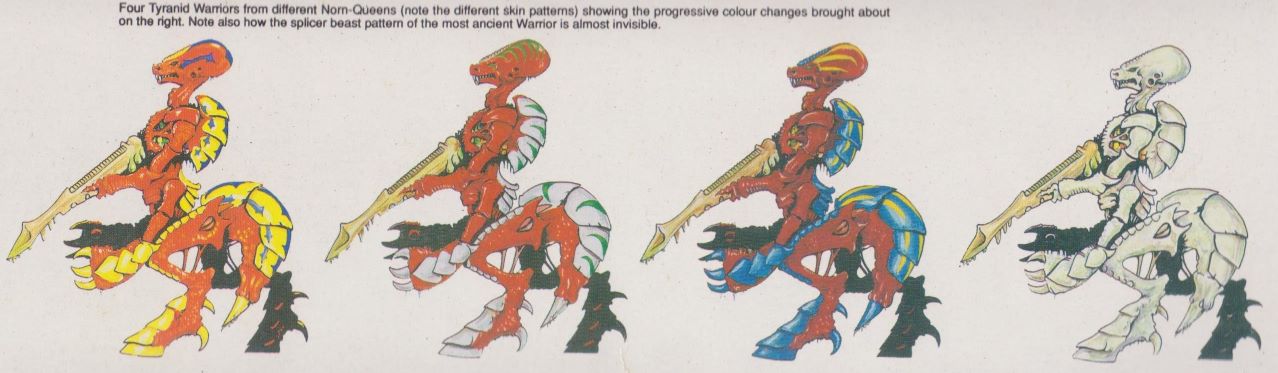
TYRANID COLOURINGS
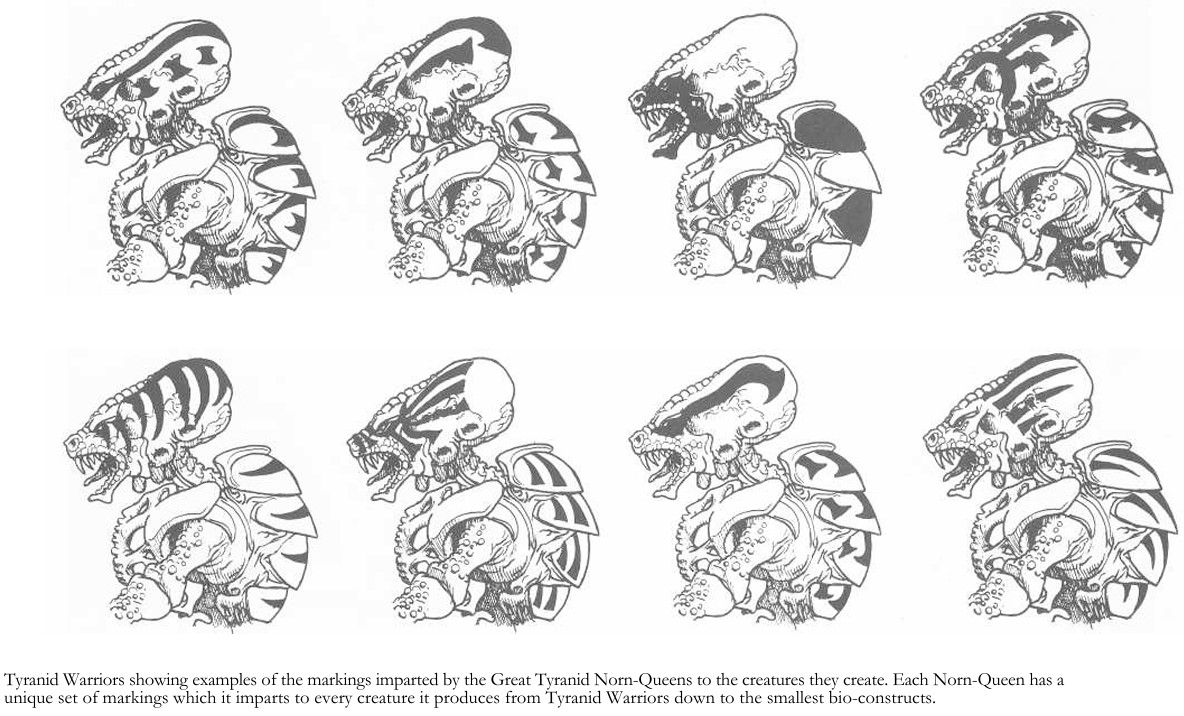
The Norn-Queen pattern which appears on all the creatures which it produces is actually comprised of a form of algal symbiote. Some example patterns are shown here and more can be found in the rules and background book.
The colours of the various patterns as they appear on Tyranids change with the warriors' general colouring which in turn alters with age. Fully grown warriors are basically bright red with pale yellow bony plates and blue markings. As they get older these colours gradually change - the red areas get darker and deeper, the yellow areas first get paler, turning white and then acquiring an ever-stronger blue tinge, while markings change from blue through green to yellow. Once a Tyranid has reached a certain age however its colouration remains fairly stable - a dark burgundy with blue plates and yellow markings. This does start to fade with time so that truly ancient Tyranids have a pale, almost bleached appearance, reminiscent of a dried cuttlefish.
I never saw these patterns or age-related schemes outside this game. Presumably they were added to give players a variety of colours to paint their miniatures.
Playing Advanced Space Crusade
The main thrust of the game doesn't involve miniatures at all. Placing board tiles and miniatures only happens during Encounters. There could be up to six Objective Encounters and a number of Ambush Encounters during a game depending on the cards drawn.
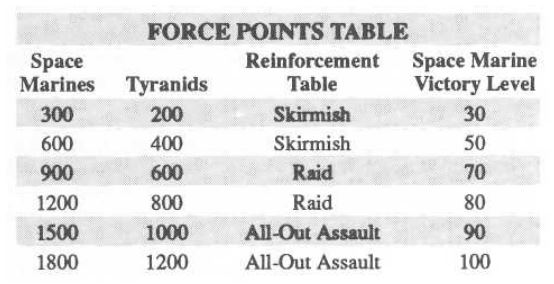
Both players create force rosters up to an agreed points size. Force rosters can be bigger than the number of miniatures because Encounters will typically use a subset of the forces involved. Six tiers dictate the size of the forces and the number of Victory Points the Space Marine player has to achieve to win the game before their forces are wiped out. The Space Marine player scores Victory Points by destroying Secondary/Primary Objectives. The Space Marine player gets the larger initial force with the Tyranid player drawing random reinforcements as the game progresses.
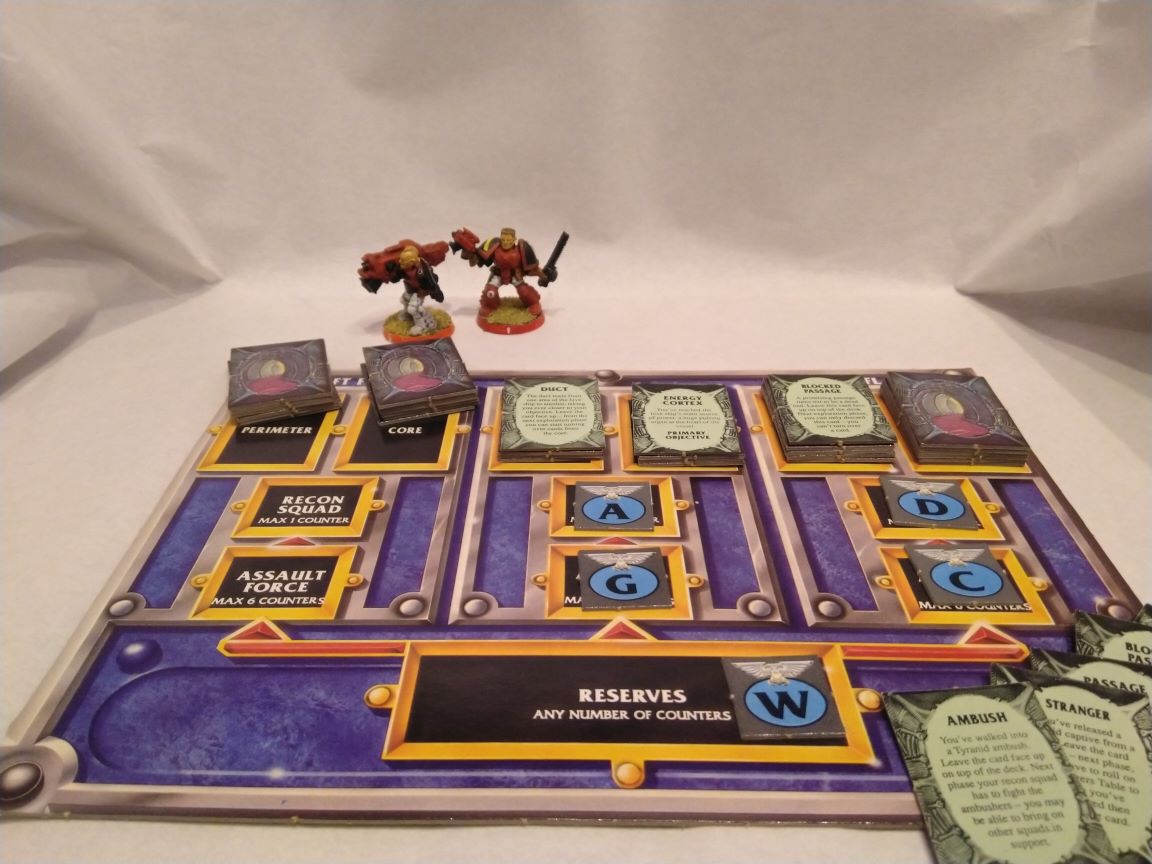
The Space Marine player uses the Strategic Display to organize forces across three avenues of attack. Space Marine exploration of the ship happens via decks of cards with forces striving to discover Secondary Objectives or Ducts to the core deck where the Primary Objectives can be found. Scouts get special rules as an incentive to place them in the Recon Squad box. Encounters happen when the Space Marine player chooses to attack a Secondary/Primary Objective or an Ambush card is drawn.
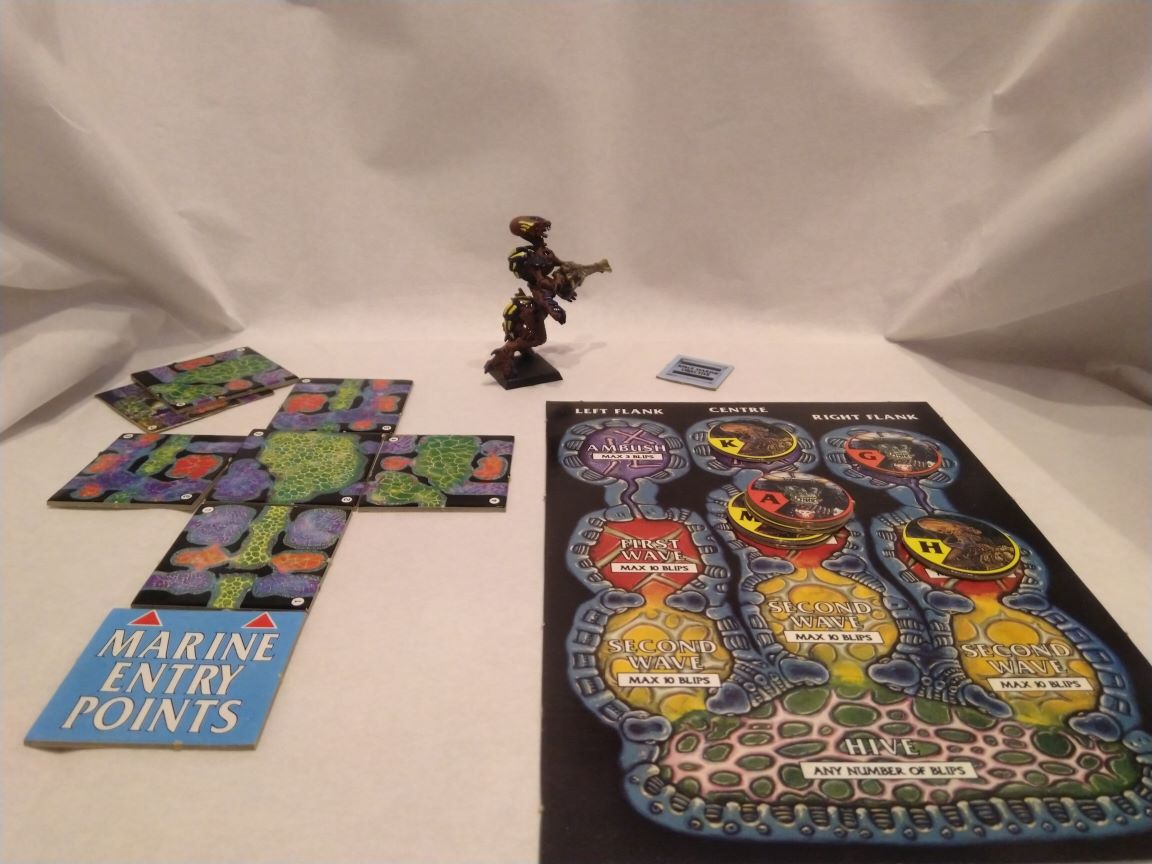
The Tyranid player places defending blips on a hidden Hive Network board. The game box doubles as a screen to conceal things from the Space Marine player.
Is Advanced Space Crusade Any Good?
It certainly didn't enjoy the same popularity as Space Hulk, a game that got three editions between 1989 and 2009, never mind the computer game adaptations. Designer Jervis Johnson has criticisms of his own work.
You could see the same kind of thing happening with Advanced Space Crusade. That's another good example of a game that was just too complicated.
-Jervis Johnson, Talking Miniatures
Players have to author force rosters. Cards have to be organised so certain ones appear in each of the six shuffled decks. There are three pages of random tables for Artifact, Stranger and Trap cards in the rulebook. Each of the six Primary and Secondary Objectives come with unique rules, some that have to be tracked for the remainder of the game. Players have to track Victory Points and what forces have been destroyed or reinforced. There are dozens of cards and counters.
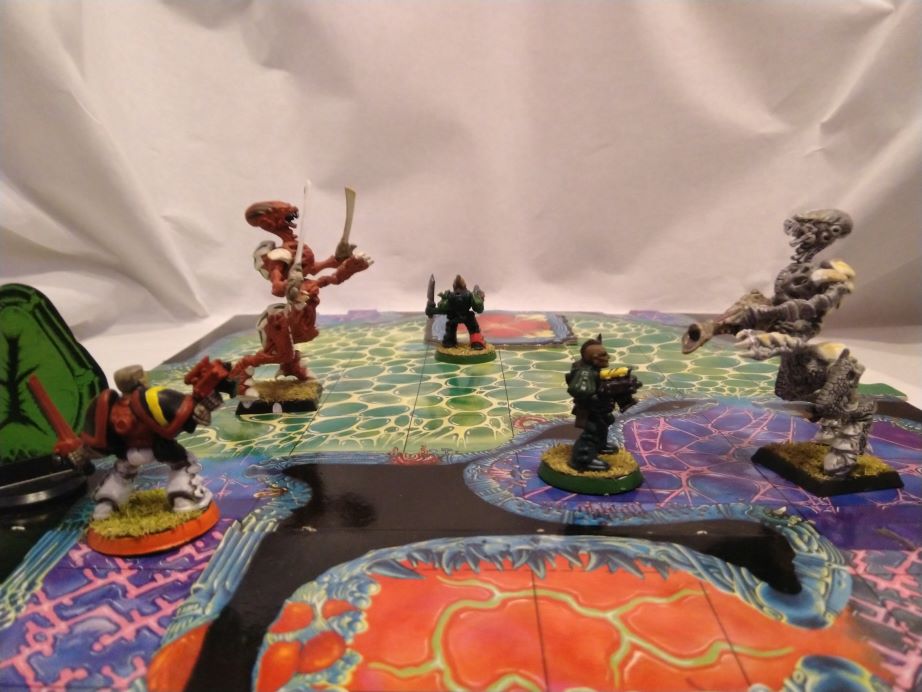
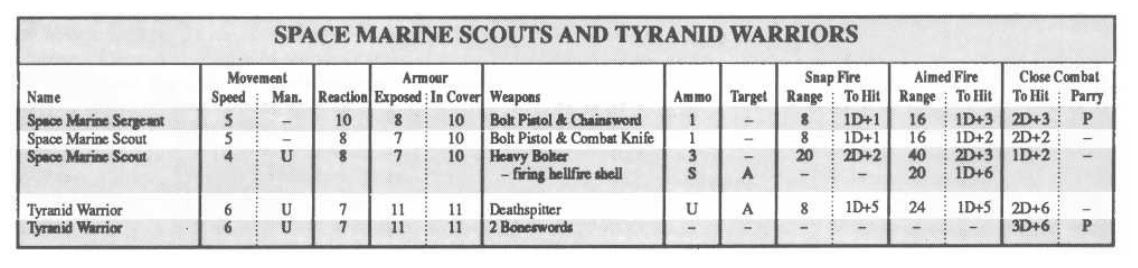
Encounter combat involves hidden miniature blips, facing, manoeuvrability, actions, reactions, extra actions, fate points, overwatch, cover, diving prone, reloading, parrying, templates, splash damage and bouncing grenades off walls.
Compared to Space Hulk there is a lot more bookkeeping and fewer narrative opportunities. The boards always represent a Tyranid hive ship and the regular shape of the tiles prevent Space Hulk's inventive layouts.
As the explorer the Space Marine player gets more agency than the Tyranid player. The Tyranid player is omniscient and performs many actions in secret which makes them part games master. The Space Marine player sometimes has to wait for the Tyranid player to make dice rolls and draw tiles and tokens out of sight which isn't much fun. Unless the Tyranid player chose to deploy the full board during an encounter they can spend several turns just watching the Space Marine player open doors into nothing to discover the tile layout. This could allow an unwise Space Marine player to isolate their models giving the Tyranid player an advantage but is otherwise pretty boring for both players.
A complete game of Advanced Space Crusade is a campaign of skirmishes. It is more likely to appeal to fans of Necromunda or Blackstone Fortress than those who want a single Warhammer 40,000 battle or a game of Space Crusade.
There's a lot to like in both the card based exploration and the Encounter combat. Perhaps more separately than together in the same game.
Miniatures
Tyranids had a few false starts when it came to miniatures - a topic for another time! With the launch of this game Tyranids received towering plastic models.
Metal Space Marine Scouts ↗ had been around for a while though lacked special rules or background. This game provided plastic scouts and recast them as young initiates led by a veteran.
The box included three 5 man squads of Space Marine Scouts and six Tyranid Warriors designed by Jes Goodwin and Bob Naismith.
One of the things I like about the Tyranid sculpt is that the rib cage is separate. You could paint the organs underneath all kinds of lurid colours if you so wished. It also gives the models a bit more depth. As primitive as they appear now these miniatures were more detailed than the GW plastics that preceded them and were better than the plastic Space Hulk miniatures of that era.
I think the Tyranids are less goofy than the 2nd edition metal Tyranid Warrior miniatures ↗ that would follow and are better than any of the 40K 2nd edition plastic infantry sculpts.
Space Marines can rescue Strangers in the form of Squats, Eldar, Imperial Guardsmen, Ogryn, Space Marines or Inquisitors. These miniatures were not included in the box and depending on card draws and dice rolls you might need more than one of each.
The core rulebook includes rules for using Space Marine heroes, Terminators and various Space Marine infantry squads. The Tyranid player can add Genestealers, Zoats, Grabber-Slashers, Hunter-Slayers, Genestealer Hybrids and Ork & Chaos Mind Slaves.
Alternative Game Modes
The rule book dedicates two pages to ways to vary the game.
-
Just set up the board tiles and fight a skirmish
-
Use Space Hulk tiles instead of the hive ship tiles
-
Chaos Space Marine players can use the Space Marine forces list with the addition of Chaos Androids and Dreadnoughts from the MB board game
-
Skew points percentages one way or the other if you find the games one-sided; Space Hulk 1st edition could be particularly hard on the Space Marine player so perhaps this option was informed by that
Expansions
An Imperial Guard Force List was published in White Dwarf 132 with officers, infantry, Ogryn, Beastmen and, err, human bombs. If the human bomb didn't explode the miniature was free to go, presumably to be eaten by Tyranids. Imperial Guard could also be used as Tyranid Mind Slaves.
White Dwarf 134 provided an Ork Warband Force List with Ork Boyz, Warboss, Oddboyz, Mad Mobz, Wild Mobz, Grotz and Ogryn. Orks had a bunch of tables to make them extra random, as was the style at the time, and even had rules for Ork Clans. WD134 also had a 7th board tile you could cut out and stick to card to fight bigger Encounters.
Both these issues had errata for the rulebook.
Related Games
Space Crusade and Advanced Space Crusade are different games targeting different audiences. Space Crusade is much more accessible. White Dwarf 134 included Space Crusade rules for miniatures from ASC.
Twenty of the scout miniatures were packaged with Space Hulk tiles in 1991's Ultra Marines ↗ . This game was aimed at beginners.
In 1993 assets from this game were repackaged with a different rule set and additional miniatures as Tyranid Attack ↗
. White Dwarf 158 gave an overview of the rules. Tyranid Attack was a single rolling battlefield with a simpler combat system. It had two expansions that I know of - Eldar in WD159 and Dreadnoughts in WD162. The unit profiles were not compatible with Advanced Space Crusade.
I have never played these related games and cannot comment on their merits.