The Dark Millennium


Article Index
- Rogue Trader
- The First Warhammer 40,000 Rules Boxed Set
- The Booklets
- Dark Millennium
- Codices
- Codex Space Wolves (1994)
- Codex Orks (1994)
- Codex Eldar (1994)
- Codex Ultramarines (1995)
- Codex Imperial Guard (1995)
- Codex Tyranids (1995)
- Codex Chaos (1996)
- Codex Angels of Death (1996)
- Codex Sisters of Battle (1997)
- Codex Assassins (1997)
- Hero Hammer
- White Dwarf
- Citadel Journal
- Scenarios
- Necrons
In a box, with miniatures and everything! An overview of the 2nd edition of Warhammer 40,000 for the uninitiated.
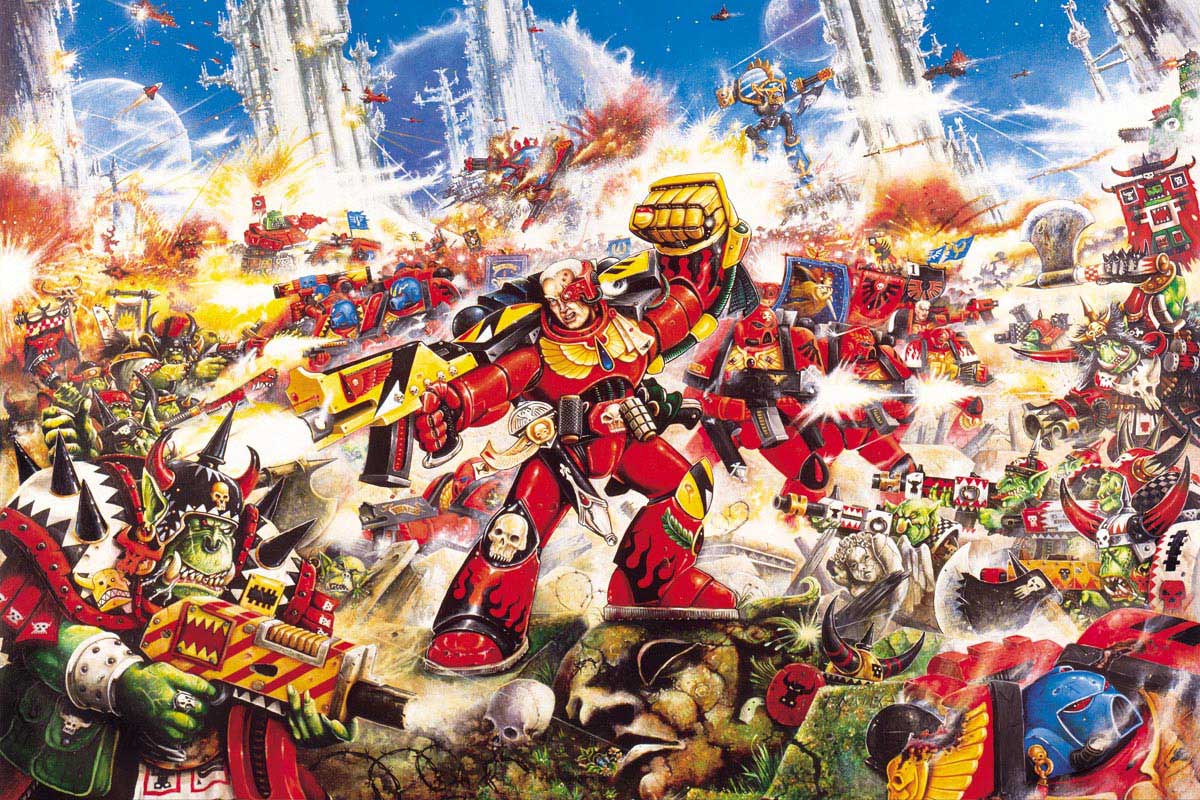
Rogue Trader
40K 1st edition was supported from 1987 until 1993. It was a messy DIY system.
Under Tom Kirby's leadership Games Workshop ↗ became more focused. 40K 2nd edition was glossier, more colourful and more accessible.
The First Warhammer 40,000 Rules Boxed Set
40K 2nd edition launched in a retail friendly box set ↗
with 80 plastic miniatures, dice, cardboard accessories and a bunch of booklets.
2nd edition took two years to develop and the tail end of the Rogue Trader rule-set looks a lot like it. Rick Priestley, Jervis Johnson and Andy Chambers excised the role-playing and many of the fiddly, time-consuming aspects. Some models were dropped but the rules were close enough that it wasn't hard to adapt anything in either direction if you had a mind to do so.
If you're a Warhammer 40,000 player already you'll know that the original game changed over the years as new rules were developed for hand-to-hand combat, vehicle combat, overwatch and so on. At the same time the game details for many of the troops changed, and special rules were introduced for new weapons. The new Warhammer 40,000 game takes all of this into account, but also revises other aspects of the game play too. Compared to the original rules this is a very different game indeed!
On the othere hand, it is a fairly natural step forward from the current version including its many supplements. The new Warhammer 40,000 does of course have the great advantage of all being in one place, rather than scattered over several books and magazine articles as was the case with the old game. Overall, the new box represents a fresh starting point for Warhammer 40,000, and it replaces in one sweep all the old material including the rulebook and supplements.
-Rick Priestley, White Dwarf 165
The game wasn't entirely complete out of the box. You had to supply your own tape measure. Rules would occasionally require other dice but there was advice on generating results using D6s.
A
D10can be represented by rolling aD6to get a high or low spread (1, 2 or 3 = low spread and 4, 5 or 6 = high spread) and then rolling a furtherD6for each spread band, ie on a low spread roll aD6and re-roll any score of6to get a spread of1to5, on a high spread add+5to the dice and re-roll any score of11to get a spread of6to10.
It was easier to just buy the correct dice.
The Booklets
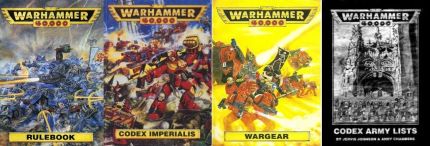
In contrast to the dense, monolithic Rogue Trader book 2nd edition has a bunch of slim staple-bound volumes. These are flimsier and less prestigious than the big book approach but have practical advantages. They can be laid flat without breaking a book spine. Players can reach for a physical object to reference a section of the rules rather than relying on indexes or bookmarks. One player can consult one book while the other player browses another.
Rulebook
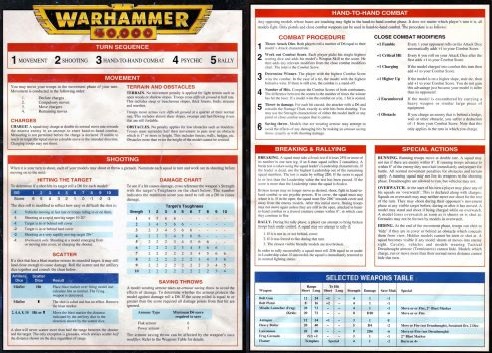
This booklet also includes model assembly instructions for the box set.
Neither player can stop placing terrain until there are at least
2D6pieces in the battle zone.
This version of the game has formal instructions about how to set up scenery and deploy troops. Players are still encouraged to create thematic battlefields.
The vehicle rules are much improved.
Every faction has a Strategy Rating with Space Marines having the best and Tyranids the worst. The player with the lowest rating has to deploy their models first. This value also influences first turn advantage. Players use Mission Cards to determine what their goals were and how they scored Victory Points. How Mission Cards are dealt is left up to players. Four turns is the recommended game length.
Wargear
This booklet covers all the guns, blades, grenades, armour and other bits of kit.
Weapon rules tend to be different rather than simpler than the Rogue Trader equivalents. Plasma guns went from being inoperable for the first two turns to needing a turn to recharge between shots. Sustained fire dice replaced the following-fire rules. Such weapons can malfunction and require a shooting phase to unjam them. Cardboard counters are provided to track these states.
Codex Imperialis
Codex Imperialis has all the lore and detailed rules for individual model types.
Some pages are purely there for flavour. Two pages are dedicated to the hierarchy of the Administratum. No rules, just job descriptions for a bunch of civilians.
"MORE BEER!" yelled Thrund, "MORE BEER!" I'm parched as a sand toad's nadgy bits. The massive Squat Lord waved his huge fists in the air and laughed loudly.
-From a half page of prose in Codex Imperialis
Codex Army Lists
As the name suggests it details army lists, specifically, Space Marines, Imperial Guard, Imperial Agents, Squats, Orks, Eldar, Chaos, Tyranids and Genestealers. The Imperial Agents list subsections detail Adeptus Arbites, Adeptus Mechanicus, Adeptus Ministorum, Adeptus Astra Telepathica, Officio Assassinorum and Inquisition. Lists are fairly dense at 2-3 pages each.
Space Slann ↗ , rarely mentioned outside the original Rogue Trader rulebook, did not make the transition.
2nd edition loosened force composition rules significantly. There are three categories of unit: characters, squads and support. You need to spend at least 25% of the points on squads, can spend up to 50% on characters and the same amount on support. Individual lists defined different limits for each, define new categories, and dictate which faction can ally with another with allies coming out of the support section. The system is open to abuse and the designers occasionally used the magazines to castigate those who let their army become too beardy.
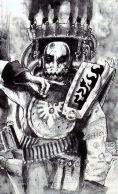
Most squads start at five models. Space Marines and Imperial Guard typically standardise on ten.
This booklet set the stage for a couple of things. The Imperial Agents Adeptus Ministorum section added the Sisters of Battle. The Tyranids list dropped many entries from the Rogue Trader list, renamed some, and added a mysterious new thing called a Hive Tyrant.
Codex Army Lists is commonly called The Black Codex by fans.
Dark Millennium
Dark Millennium ↗ is a boxed expansion containing cards, counters, templates and a rulebook ↗ . The 60 psychic power and warp cards make up most of the expansion. Powers are army-specific. Strategy cards can be played to force one-off events. Vehicle cards can enhance vehicles for a points cost.
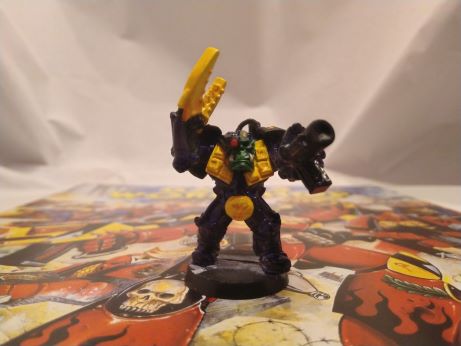
Dark Millenium significantly increases the psychic potency of the Grey Knight Terminators ↗
in the Inquisition section of the Imperial Agents list. Initially limited to Level 1 the supplement allowed a unit to be any level.
The Ork Weirdboy is one of the weaker psykers in the original box rules. In Dark Millennium Orks get unique Waaagh! Power rules and an improved Warphead profile.
White Dwarf 170 gave a rundown of the box contents.
Codices
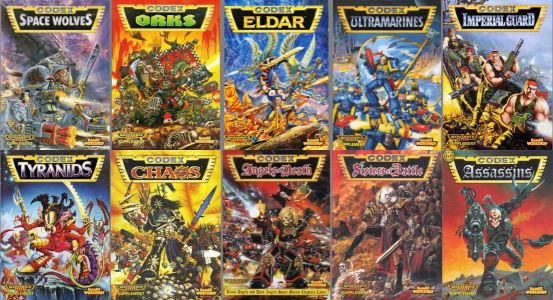
A significant part of the appeal of 2nd edition is that it was just more organised than Rogue Trader. Launch box, models, codex. It is pretty clear what you needed to buy to play an army. It remains one of the simplest editions of 40K.
Codex Space Wolves (1994)
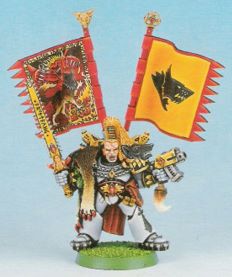
I suspect Space Wolves were the first Space Marines to get a codex because they were just ready to go. The codex is a hair's breadth from the army list published for Rogue Trader (WD156/WD157/WD158) and the boxed models had already been released.
Codex Orks (1994)
Rogue Trader had over a 100 Ork units. 2nd edition drastically reduces that number but that's mostly a result of condensing six overlapping clan lists into one. Some of the more esoteric units from Freebooterz disappeared completely.
The 2nd edition Ork model range ↗ reflects the Flanderization ↗ of their rules. Wealthy Bad Moonz ↗ get all the armour; Goffs ↗ get all the horns. Blood Axe Kommandos ↗ fight alongside their fellow WW2 inspired Stormboyz ↗ . Snakebitez ↗ lean into a crude New World ↗ aesthetic no doubt inspired by cowboy movies.


Codex Eldar (1994)
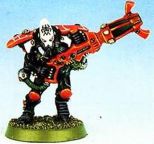
The main additions in this book were to the Aspect Warriors with six Phoenix Lords for the existing aspects. The Warp Spiders and Shining Spears were introduced, though only the former had miniatures. Pirates and Exodite Dragon Knights formed part of the main list while a significant chunk of the support section was given over to Harlequins.
Codex Ultramarines (1995)
The Ultramarines army list doubles as that of Space Marines in general.
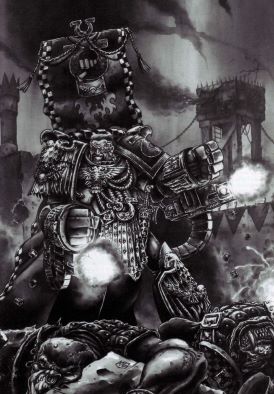
This book also includes a Legion of the Damned unit.
Codex Imperial Guard (1995)
In Rogue Trader Imperial Guard infantry largely mimicked other armies in that they had tactical, assault and heavy weapon squads. 2nd edition restructures them into a shooting force with a unique organisation.
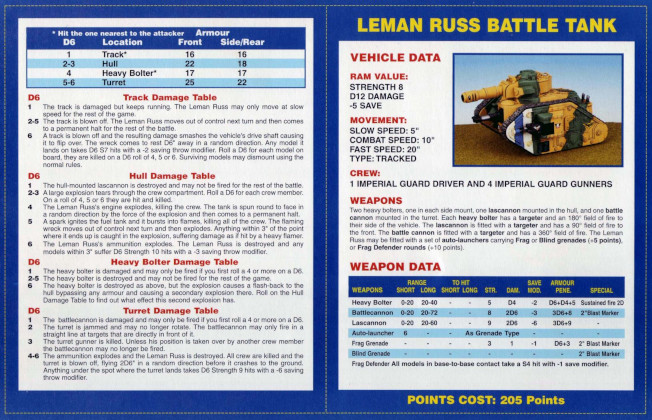
The biggest change is the addition of all the tanks. Rhinos and Landraiders are replaced by a host of dedicated plastic kits: Leman Russ; Demolisher; Chimera; Hellhound; Basilisk; Griffon. Imperial Guard became the army for the tread-heads.
Codex Tyranids (1995)
2nd edition drops a bunch of units from the Rogue Trader army list - Zoats, Mind Slaves and Squigs. Metal Hormagaunts, Gargoyles, Hive Tyrants, Zoanthropes, Biovores, Spore Mines, Rippers and Lictors are in.
Tyranids cannot take allies, not even from the Genestealer Cult list in the same codex. They also can't use strategy cards but make up for it with event tables that can adversely affect enemy units at the start of the battle.
Codex Chaos (1996)
The 2nd edition codex is where Chaos Space Marines coalesced into their modern form. Rogue Trader's Realms of Chaos books had five army lists across two volumes. This codex condenses them into one with a special unit type for each chaos god.
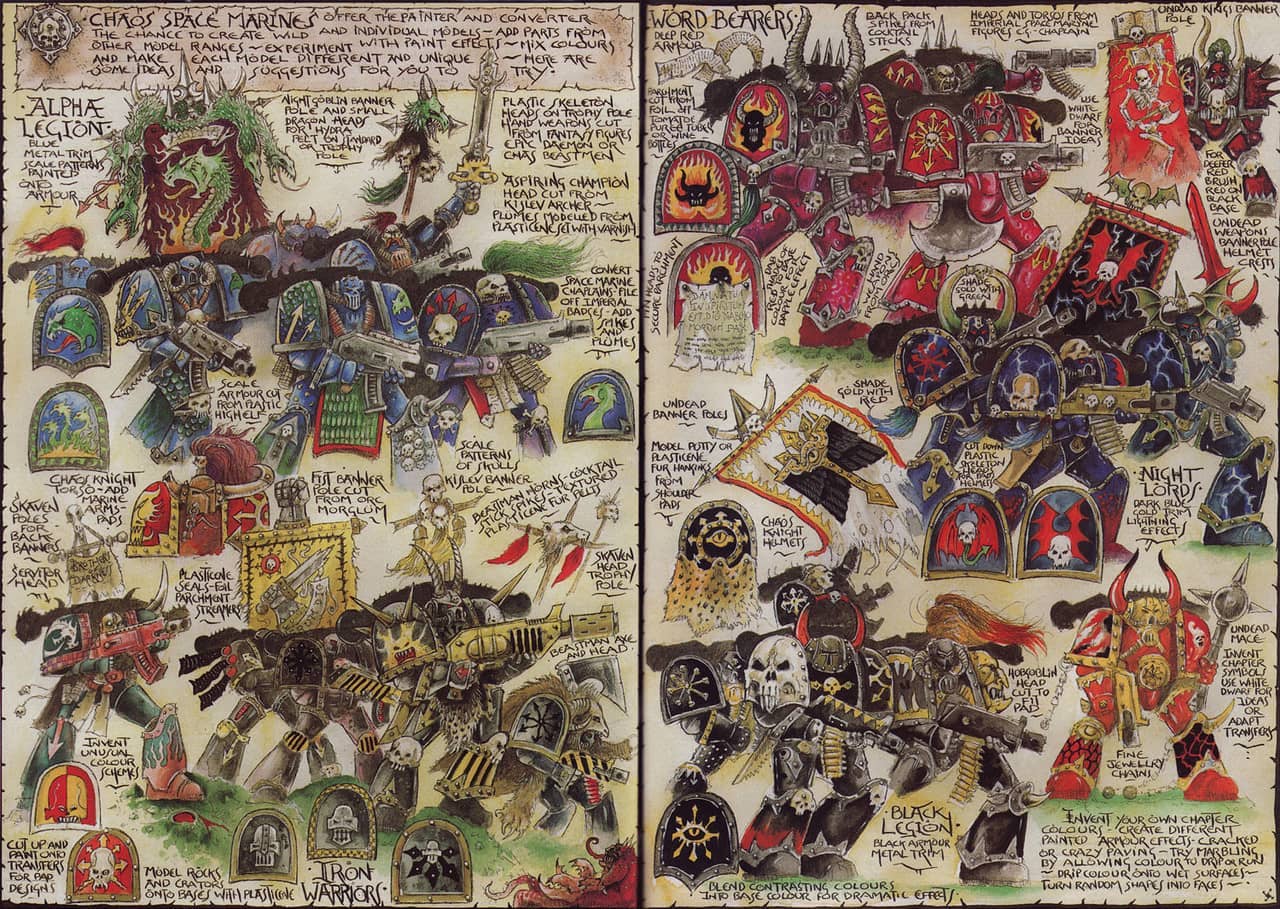
2nd edition's Chaos Space Marine miniatures ↗ look a lot closer to their imperial brethren than previous models. Two supplementary lists, Chaos Cults and Chaos Daemon Worlds, are a nod to Realms of Chaos.
Codex Angels of Death (1996)
Angels of Death is a joint codex for Dark Angels and Blood Angels. These armies replicate the Ultramarines list but with a few unique squad types, special characters and wargear.
Codex Sisters of Battle (1997)
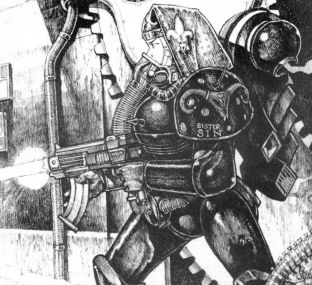
In Rogue Trader the Adepta Sororitas were one picture and a few paragraphs of text. There were a pair of armoured Female Warriors in the Adventurers range ↗ but these were withdrawn due to poor sales.
The 2nd edition Sisters of Battle range ↗ was a new set of metal miniatures supported by a couple of Rhino tank types.
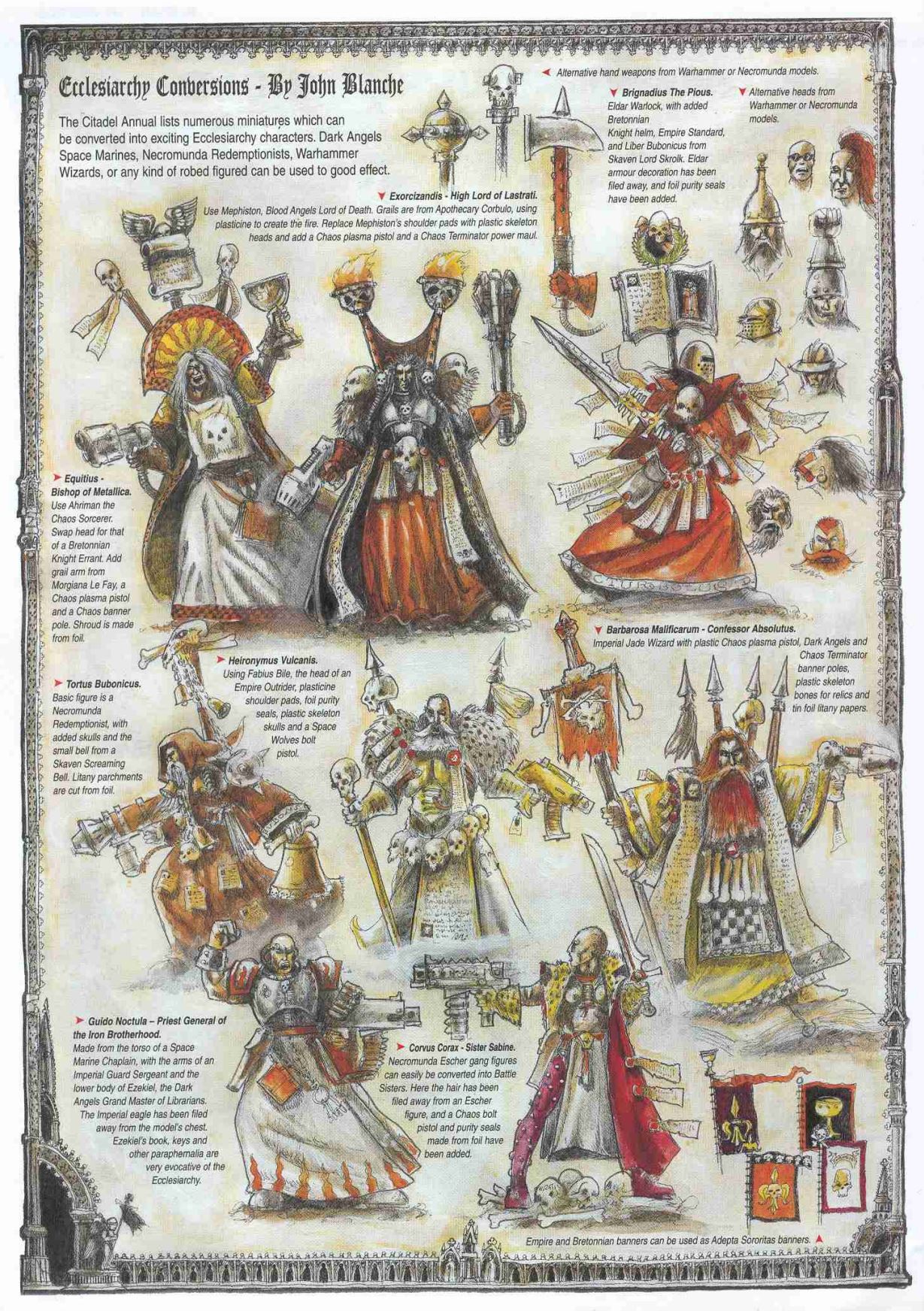
Joining the sisters are a trio of priest types and civilian Frateris Militia Bands. Frateris Militia rival Gretchin in effectiveness and their uninspiring models ↗ don't help their cause. You can improve their utility by mounting them on horses, perhaps proxying in Warhammer Fantasy Battle miniatures, to represent subjects from the Imperium's more primitive worlds.
Codex Assassins (1997)
The assassin in Codex Imperialis/Codex Army Lists is an up-gunned version of the Rogue Trader version with a wide range of wargear options.
Codex Assassins introduces the temple assassins ↗ and their models: Callidus, Cullexis, Eversor & Vindicare.
Hero Hammer
Heroes tend to be more powerful than in Rogue Trader and can only be targeted if they have not joined a unit and are the closest target.
Compare a Rogue Trader Space Marine Major Hero to the 2nd edition Mighty Hero and Chief Librarian profiles.
| 40K | Troop Type | M | WS | BS | S | T | W | I | A | Ld |
|---|---|---|---|---|---|---|---|---|---|---|
| Rogue Trader | Space Marine Major Hero | 4 | 6 | 6 | 4 | 4 | 3 | 6 | 3 | 9 |
| 2nd | Space Marine Mighty Hero | 4 | 7 | 7 | 5 | 5 | 3 | 7 | 3 | 10 |
| 2nd | Chief Librarian | 4 | 7 | 7 | 5 | 5 | 4 | 7 | 3 | 9 |
Psykers are especially powerful in 2nd edition. Loaded out with unique wargear, special characters are often one-model armies.
White Dwarf
For the 40K fan comparatively little of what was published in White Dwarf magazine during 2nd edition is essential in the same way it had been during Rogue Trader. Most of the 40K content ↗ is excerpts from the codices.
That said, there was some good stuff. The battle reports and campaigns were always entertaining reads. This era of White Dwarf often had card sections as a mechanism for distributing new mission, strategy, wargear and vehicle cards. There was also the odd Q&A about the rules.
A bunch of WD articles were aggregated in Warhammer 40,000 Battles ↗
.
Citadel Journal
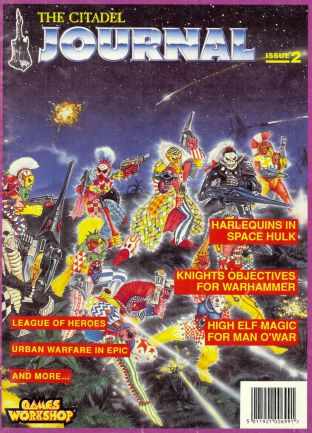
Citadel Journal was a new magazine dedicated to gaming articles authored by trainee games designers and fans. It had an imperial ton of content for 2nd edition. See Rick Priestley's Second Pair of Arms for a list of 2nd edition articles.
Scenarios
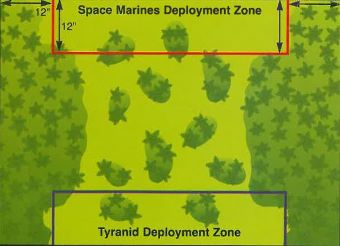
Drawing mission cards isn't the only way to play 2nd edition. White Dwarf 210's Bloodscent scenario describes a dense jungle battlefield from which Blood Angels have to escape the clutches of a Tyranid swarm by exiting via the Tyranid deployment board edge. Tyranid reinforcements can enter to the Blood Angels' rear or flanks to harry them.
There are lots of ways of modelling jungle areas for your battlefield including using aquarium plants (often weirdly coloured which great for alien vegetation), lichen from model shops or your garden, or at a pinch just using pieces of green paper, felt or cloth to mark the edges. Easy really.
-Mark Brendan, White Dwarf 210
Necrons
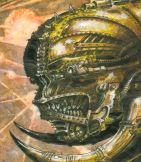
White Dwarf 217 introduced the mysterious Necrons with a free model on the cover. WD218 has a 4-unit army list and a battle report. They had a small metal model range ↗
.