Warty Thou's Dark Age of Technology


Article Index
- Combat 3000 (1979)
- Laserburn (1980)
- Combat 3001 (1981)
- Imperial Commander (1981)
- Reaper - Fantasy Wargame Rules (1981)
- Forces of the Imperium (1982)
- Warhammer - The Mass Combat Fantasy Role-Playing Game (1983)
- The First Citadel Compendium - An Irregular Journal (1983)
- Warhammer 2nd Edition (1984)
- White Dwarf 94 (1987)
The origins of the Warhammer 40,000 ↗ tabletop war game. A brief tour through the Combat 3000, Laserburn, Imperial Commander, Reaper and Warhammer war games that preceded Rogue Trader.
Warhammer 40,000 has its origins in youthful enthusiasm intersecting with a relatively nascent science fiction & fantasy miniatures industry. Filmdeg Miniatures' videos "Rick Priestley on the history of Warhammer 40k ↗ " and "Rick Priestley and Jervis Johnson on Richard Halliwell ↗ " cover some of those early days. The Jordan Sorcery ↗ interview "Rick Priestley on the Influences Behind Warhammer 40k ↗ " is worth watching. The Awesome Lies blog ↗ has an interview with Priestley that covers some of these games if you prefer text.
Most of the publications mentioned predate my knowledge of and interest in war games so some of what follows may be apocryphal.
Combat 3000 (1979)
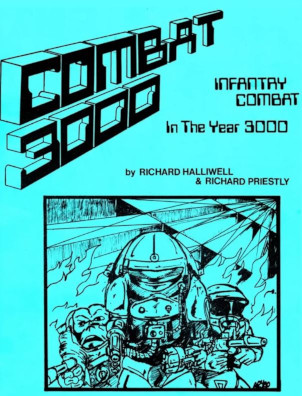
Richard Halliwell ↗ and Richard Priestley ↗ published the Combat 3000 war game with Tabletop Games ↗ , a defunct company also known as TTG, Tabletop Miniatures and Tabletop Figures.
Boldly go where no man has probably gone before or even want to go.
-Combat 3000's rules are better than some of the grammar
Combat 3000 was a 38 page booklet. The introduction claims this is a more polished version of an unpublished ruleset designed in the previous year. There are profiles for creatures, guns, ammunition, close combat weapons, sights, weapon mounts, vehicles, armour, and partial armour.
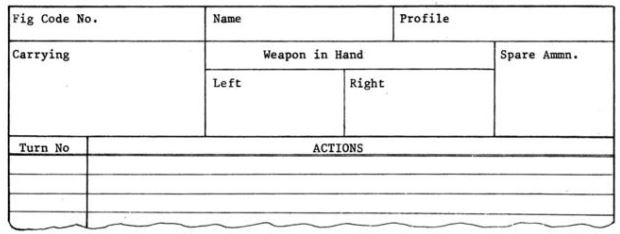
In games where players control more than one figure each they must write games orders for each figure before the game starts.
Where players control more than one figure, then one of these figures must be detailed as the commander of the group. All game and new orders will originate from this figure.
There are 25 listed actions a miniature could make, many with more detailed subrules. Actions include "crouch", "rise from crouch", "sling rifle", "smash window" and "remove helmet". Actions typically take one to three turns. They don't include rules for putting a helmet back on. There are a plethora of guns including ten different laserguns, a Magnum 1044, an Ormand Hammerstaff, and an Ixtyl 'Organiser. An Ixtyl 'Organiser appears to be a multi-barrelled gun of some sort.
The rules typically require players to apply modifiers to see if their miniature can do something and then roll percentage dice (a D100 represented by two D10s) to test for success.
Combat 3000 Miniatures
The game recommends miniatures should be mounted on 20mm bases, the size of a new penny ↗
. There are four creature profiles & I believe all the miniatures mentioned were 15mmish.
| Creatures | Manufacturer |
|---|---|
| Humans | Asgard ↗ , Garrison ↗ , Minifigs ↗ , Citadel ↗ |
| Trimotes | Asgard |
| Mandiblax | Asgard |
| Zarquin | Minifigs |
Trimotes ↗ are three-armed aliens. I didn't find much on the Mandiblax but assume the Mandiplex are the same thing by a different name. Zarquins ↗ are bipedal insectoids.
Alternative Armies ↗ sell some of the Asgard stuff. You can see some painted examples on the Deathzap blog ↗ .
Laserburn (1980)
These rules were written originally as an adjunct to the various Sci Fi role playing rules available...
TTG's Laserburn was written by Bryan Ansell ↗
who had an on/off relationship with Games Workshop prior to becoming managing director in 1985.
The game is designed for 12 to 20 miniatures a side. As an alternative to using it with a roleplaying system it is suggested that participants "play a connected series of games which will form a kind of saga involving your own characters."
The game uses a D100 system. There is a lot of latitude in choosing forces and equipment. The 15mm miniatures listed on page 38 were those supplied by Tabletop Figures ↗
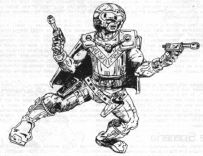
. These include models in Power Armour and Dreadnought Armour, the latter being more akin to 40K's Terminators than 40K's Dreadnoughts. It is suggested that if aliens were required that players adjust the human profiles. Like Combat 3000 before it some rules could be ignored for larger games or to just speed things up. Weapons like needle guns, hand flamers and conversion beam projectors will be familiar to 40K players.
Laserburn is for sale on the Alternative Armies website ↗ along with suitable miniatures. I am not sure where the line between Asgard and TTG miniatures was drawn.
The Alegis Downport blog describes playing Laserburn ↗ .
Laserburn Background
The main powers in play are the fractious Imperium and the Red Redemption which are described as parallels with the same basic power structures. Both tend to be threats to the players' adventurers.
The Inquisition provides all the candidates for High Lordship, and a good proportion of the Imperium's Lord Knights, its ranks supply a dedicated, even fanatic, cadre around which the ordinary armed and security forces are built. Inquisition H.Q. on Earth is notorious for its Gothic horrors, here the Lord Torturer has brought his art to a screaming pitch of subtlety and terror.
The force of the Red Redemption, both regular military units, and the fanatical civilian hordes follow the cry for a holy war, are led, both militarily and spiritually by the Brothers and Masters of the inner circle. These rabid fanatics have their flesh flayed from them and then replaced with a metal carapace.
The Redemption "devote themselves to Allah, Lord of the fiery hells" and are from planets "colonised mainly by African and Near-Eastern groups." Even by the standards of the time that's a bit outré.
Merchant Barons are described as quasi-independent individuals with private armed forces who might have allegiance to either or neither of the superpowers. Laserburn's Merchant Barons share all the qualities of 40K's Rogue Traders. Alien slavers and mysterious warriors of terror each get a paragraph.
Laserburn Scenarios
The booklet includes a page with four lightly described scenarios.
SHOT BY BOTH SIDES
The players hire out to the Imperial Inquisition as assassins. Heavily armed, they are infiltrated amongst the foreign delegates of the court of King Grotspox The Flatulent; One third of the King's dreaded Black Guard have been bought off, but it's impossible to tell which ones. Not only the King, but also the foreign delegates and their bodyguards (fortunately only armed with ceremonial swords) must die; so that the attack can be blamed on Red Redemptionist fanatics.
Unexpectedly, a group of genuine Red Redemptionists in full ceremonial robes, and armed to the teeth; obviously honoured guests, appear amongst the throng. Have the players been sold down the river? The only thing for certain is that the Inquisition demands success or death(!)
The tone is tongue in cheek. One scenario involves recovering black-market genitalia from an Organlegger Baron. Another involves sewer combat, Android Liberation Frontists and Giant Mutant Rats.
Combat 3001 (1981)
This supplement to Combat 3000 includes corrections to the core game, advanced rules and additional species, weapons & equipment.
Imperial Commander (1981)
Lead fanatic hordes of Redemptionists to cleanse, purify and generally obliterate everything and every one in the very heart of the Imperium.
Hate people a lot.
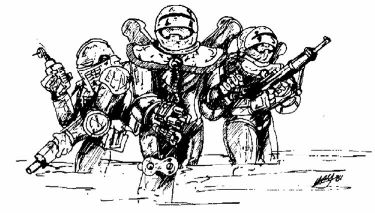
Although associated with Laserburn and utilising the same miniatures this is a separate D6 based game. Imperial Commander was written by Bryan Ansell & Richard Halliwell and enabled fielding larger forces but that's not all. Imperial Commander has army lists "to choose armies of roughly equal strength for competitive games" generated from the anticipated Forces of the Imperium publication.
Imperial Commander is built around the Tabletop Figurines range of 15mm Sci Fi figures, and are designed to give a fast, skillful game when using around 50 figures per side.
Guns have up to three hit numbers at various ranges which the firing player has to beat on 2D6. Skill and equipment modifiers can adjust the hit number. Guns have an impact type (high, low, stun, etc.) each with their own table with a D6 result required for each armour type to remove the target from play. There is a bit of bookkeeping involved as guns could run out of ammunition and can only reload by remaining stationary and rolling 5+ on a D6.
Reaper - Fantasy Wargame Rules (1981)
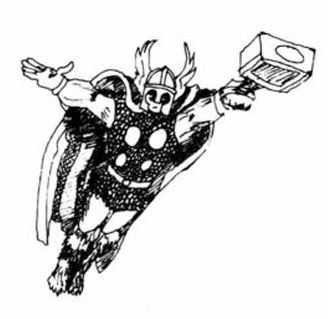
Reaper is another TTG publication by Richard Halliwell and Rick Priestley. Reaper is a Tolkienesque fantasy game. This is actually the second edition with the first released three years prior.
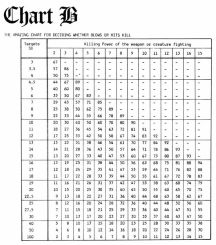
This may sound complex but it isn't. eg. KP 6, target strength value 12 =
1/2= 50% chance of killing. Also a chart is provided (Chart 'B') - read down from the Killing Power line and across to the Target Strength Value line to get the final percentage chance of killing the target. When this figure has been found, multiply it by the number of figures that have hit or struck blows.
This is another percentile based game. You can see the bones of Warhammer in this game. Reaper has a lot more charts and topless women. The tendency to assign letter codes to things instead of a numerical value was carried into Warhammer's first edition. Magicians can have a grade from (worst) A to (best) Z.
Forces of the Imperium (1982)
Being details of the organisation, equipment and vehicles of the forces of the Emperor and his Lord Knights. Includes Infantry, Black Guard, Scouts, Law Officers & Mercenaries.
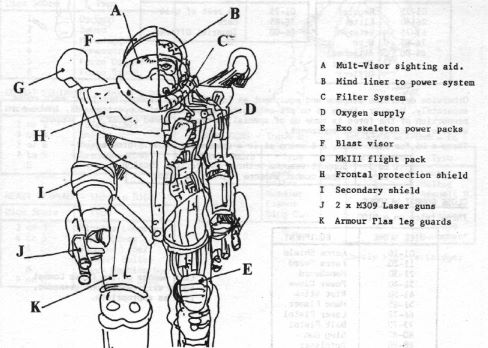
Laserburn has a few supplements, notably Ansell's Forces of the Imperium which could also be used with Imperial Commander which relied on it but was published earlier.
Forces of the Imperium is full of D100 equipment generation charts. Agents of the Inquisition have a 5% chance of being present in forces of 50 or more.
Warhammer - The Mass Combat Fantasy Role-Playing Game (1983)
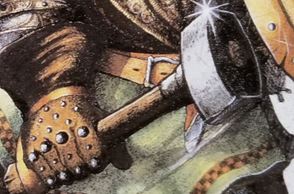
The first edition of Warhammer consists of three volumes - Tabletop Battles, Magic, and Characters. The rules were authored by Bryan Ansell, Richard Halliwell & Rick Priestley. Like the previous games by these authors it has relatively primitive type setting and layout. John Blanche's art adds a little class.
When you fight tabletop battles it becomes convenient to organise troops into Units or Regiments. A Regiment may be between 5 and 50 figures strong and should be of the same sort of troops throughout...
The main thrust of the Tabletop Battles book is combat involving blocks of miniatures. The rules are adaptable - it's not all rank & file fighting. There's a page on dungeoneering ↗ and another on flying creatures.
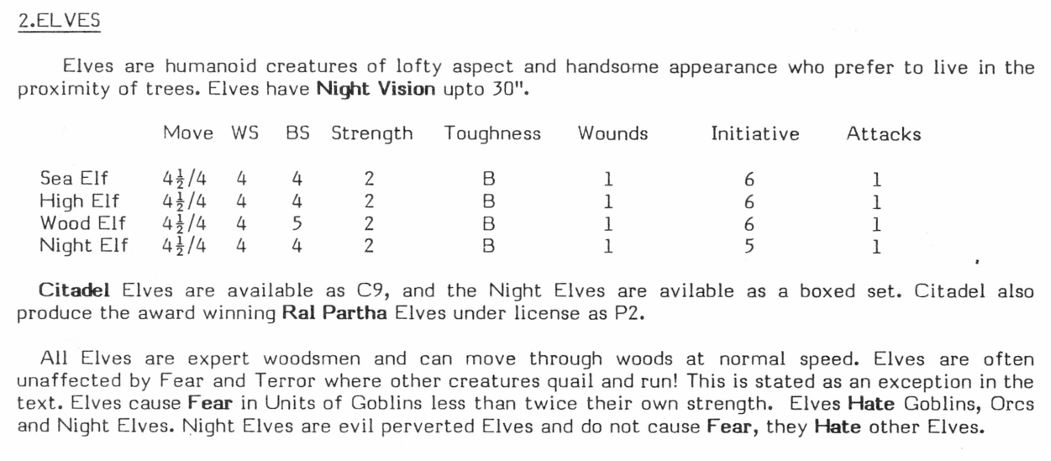
Warhammer's Tabletop Battles book uses D6 based rules. The other two volumes provide the role-playing aspects of the game with tables of D100 randomness.
Many of the core rules will be familiar to anyone who has played the first couple of editions of 40K. The toughness grade is a range of values from A to F but is functionally equivalent to toughness 1 to 6.
The book is explicit about what Citadel ↗ or, licensed at the time, Ral Partha ↗ miniature ranges are suitable for each faction.
According to Priestley ↗ the game is split into three volumes because it made production easier.
The First Citadel Compendium - An Irregular Journal (1983)
LEAD: Our models are intended for collectors and as playing pieces for serious games, THEY ARE NOT TOYS.
Citadel Miniatures contain lead, which can be harmful if ingested, there is no danger if you are sensible.
Please!
DO NOT PUT THEM IN YOUR MOUTH
DO NOT BUY THEM FOR SMALL CHILDREN
The First Citadel Compendium ↗
is a miniatures catalogue packaged with some war game articles. It is notable for a few reasons. Bryan Ansell's introduction ↗
mentions the development of a new game called Rogue Trader. The compendium also includes science fiction rules for Warhammer ↗
, Ansell's Warhammer rules for Chaos, and an advert for Realm of Chaos ↗
which would eventually turn up in two volumes ↗
in 1988 & 1990.
ROGUE TRADER: our Science Fiction Role Playing Game. We'll be re-making and re-titling our Spacefarers models to coincide with the release of these.
C100 Spacefarers ↗ were an existing miniatures range. The Miniatures Workshop site has some painted examples ↗ . The Perry twins designed them, which is surprising given their preference for historical miniatures ↗ .
Citadel's SF Role Play System ROGUE TRADER by Rick Priestley
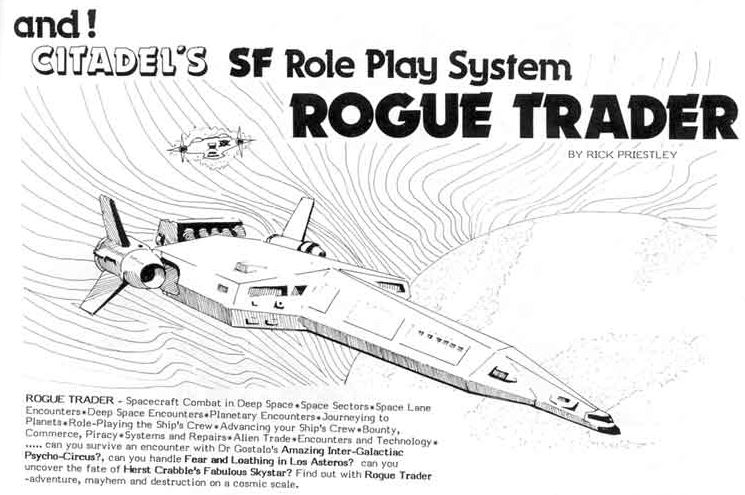
Rogue Trader was conceived as a spaceship game. The 1983 Rogue Trader advert ↗
in The First Citadel Compendium described a system at variance with the eventual work.
| Advert Feature | Rogue Trader as Published |
|---|---|
| Spacecraft Combat | No |
| Space Sectors | What? |
| Space Lane Encounters | No |
| Planetary Encounters | Games are mostly on planets |
| Journeying to Planets | Your miniatures got there somehow |
| Role-Playing the Ship's Crew | Kind of |
| Bounty, Commerce, Piracy | Not really |
| Systems and Repairs | No |
| Alien Trade | Nope |
| Encounters and Technology | You could encounter an enemy and shoot them with your technology |
.... can you survive an encounter with Dr Glostalo's Amazing Inter-Galactic Psycho-Circus?, can you handle Fear and Loathing in Los Asteros? can you uncover the fate of Herst Crabble's Fabulous Skystar? Find out with Rogue Trader - adventure, mayhem and destruction on a cosmic scale.
Warhammer 2nd Edition (1984)
Dedicated to Phil Barker ↗ , Donald Featherstone ↗ and Michael Moorcock ↗ whose fault it all is
Warhammer's second edition is much more professionally produced with better art, sketches, layout & even a little photography. The books that form it are Battles, Battle Magic, and Battle Bestiary.
The Combat volume contain rules divided into three sections, Basic, Advanced and Expert. The Basic set provides the gamer with all the essential rules and information needed to enact a Warhammer Game. The Advanced section provides experienced players with a selection of alternative rules, which can be used to expand the game. The Expert section comprises of further rules and suggestions which very experienced players might like to try out, or use as ideas for their own rule innovations.
This edition both refined & added rules. New rules include war engines, buildings, setting things on fire, and sci-fi weapons.
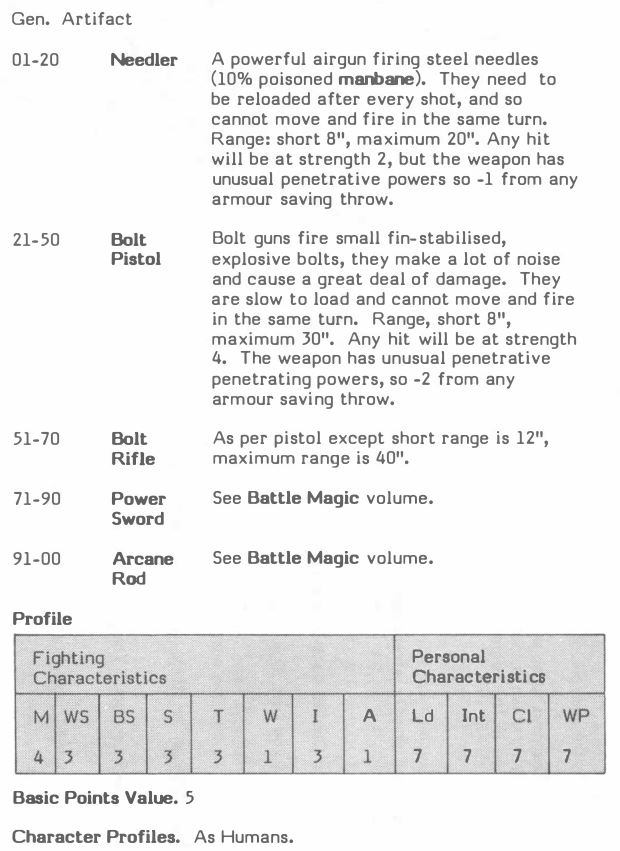
The infantry characteristics used in Warhammer 2nd edition are identical to those in Rogue Trader.
Although Warhammer has been designed around standard 25-30mm high metal models there is no reason why players shouldn't use any of the currently available plastic 54mm models instead. Citadel plan to release a comprehensive range of plastic models in 60mm scale ↗ , compatible with, and suitably heroic looking when placed alongside models form Britains, Matchbox, Airfix etc.
White Dwarf 94 (1987)

Rogue Trader was released in 1987. WD92 had a teaser advert on the inside cover. WD93 gave an overview of the game and its artwork. WD94 dedicated two pages to the game's development in its Marginalia column written by the game's author, Rick Priestley.
Warhammer 40,000 arrived at Citadel Miniatures five years ago, when I did. The game, then called Rogue Trader, was envisaged as one of a series of short, 'freebie' games which would be sent out to mail order customers.
Warhammer Battle's popularity established the format for future games. Rogue Trader had to be rethought from the ground up...
Work on Rogue Trader proceeded at a pace which can only be described as 'fitful'. I put it to one side to do Judge Dredd and the Warhammer Battle 2nd Edition rules. WHB2 benefitted from some of the development put into Rogue Trader: many of the new ideas which had been earmarked for Trader were incorporated into it. By now the 'dark and dangerous' background for Warhammer had started to evolve, partly based on ideas from Bryan Ansell, and partly on the background for the Citadel Miniatures ranges.
At this point, Rogue Trader existed only as a computer printout. And Games Workshop had shifted all development work onto new computers. Whizzo stuff, to be sure, but faced with the prospect of typing Rogue Trader into another computer, I opted for another rewrite. WH40K has been written three times, but I think it is the better for it - not something that I can say for the author...
Miniatures had started appearing in 1985, including the LE2 Imperial Space Marine ↗
.
Most of the article is concerned with how Warhammer rules needed to be adapted to suit a game focused on ranged combat. It is all fascinating stuff.
By the time the game was ready for editing in December 1986, Games Workshop had decided to produce Rogue Trooper ↗ . The ensuing confusion was incredible, with people talking about Trader when they meant Trooper and Trooper when they meant Trader. Gurgling quietly often became the only option.
A new title was needed, and some bright spark (whom I shall hate for the rest of my life) came up with Warhammer 40,000. Because of the ensuing confusion over Warhammer Battle, Warhammer Fantasy Roleplay and Warhammer 40,000 (see gurgling, above) the full title is Warhammer 40,000 - Rogue Trader, which neatly abbreviates to WH40K or 40-Kay in conversation. I prefer 'Warty thou' myself...