The Age of Battle


Article Index
The big rulebook strikes back. An overview of the 3rd edition of Warhammer 40,000.
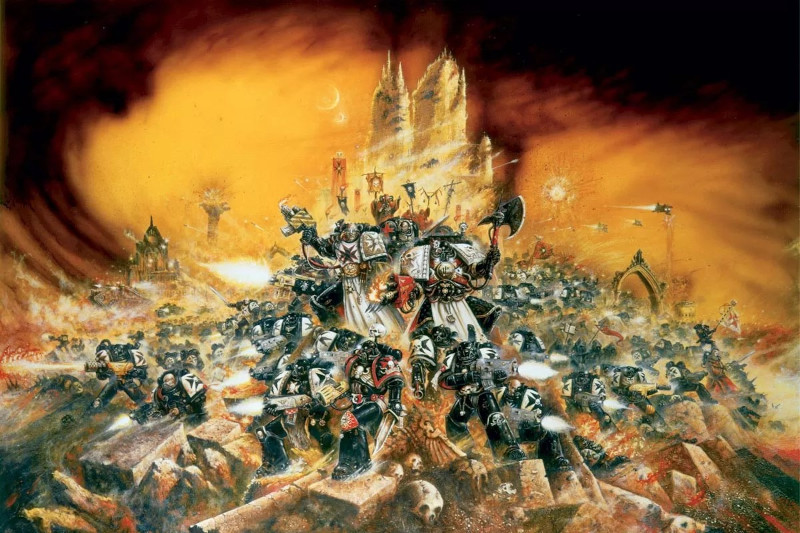
I dropped out of the hobby during 3rd edition. I've done my best to fill in the blanks.
3rd Edition Box Set (1998)
The 3rd edition boxed set includes a rulebook, gaming accessories and 31 miniatures. The miniature count is much reduced from the 2nd edition box but the miniatures are higher quality. The game uses plastic instead of cardboard for its templates and scenery. While 2nd edition has a 2D cardboard Ork Dreadnought this edition has a plastic Space Marine Landspeeder ↗
.

The Rulebook
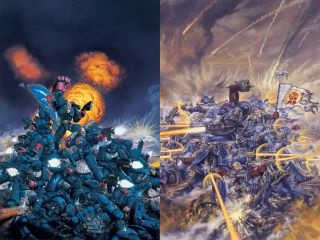
The 3rd edition rulebook harks back to the Rogue Trader book in look and heft but has significant rule changes. The basic structure of the game remains the same and some things, like the wound chart, are carried over but a lot is done to streamline the system.
The game is more abstract. Most of the modifier arithmetic is eliminated. Grenades are largely an effect rather than a weapon. Smaller vehicles use infantry-like model stats. You can no longer set models on fire. Overwatch and hiding are no longer things. The direction of facing of non-vehicle models is irrelevant. Squads are the focus rather than individual models.
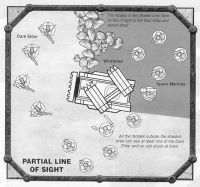
Personally, I appreciate how quickly everything can be resolved. Standard 6" infantry movement increases the pace. Tracking wounds and vehicle damage are the main remaining bookkeeping tasks. The edition introduces some interesting mechanics, like the crossfire rule that allows you to eliminate fleeing enemies through positioning.
Second edition Warhammer 40,000 adapted the original rules for larger actions, introduced victory conditions, working rules for psychic powers and vehicles, plus full army lists for different races in the form of Codex books. Nonetheless, the second edition was really a reworking of the Rogue Trader version of the game, oriented towards skirmish level combat rather than full-on battles. Not that anybody was put off trying to fight big battles of course, but the rules tended to emphasise the power of characters and individual vehicles against a backdrop of massed troops dying in droves and achieving very little.
And so it came to pass that we started the third edition of the rules wanting to make it a game for fighting dirty, great battles. As an interesting aside we had published Necromunda and Gorkamorka in the intervening time, both skirmish games which amply illustrated the strengths of 40K rules for fighting out small scale fights between gangs. We also produced Epic 40,000, the game of really, really huge battles, which included lots of innovative rules. These new games all helped to make it apparent that Warhammer 40,000 needed to have some major reconstructive surgery if it was going to comfortably handle battles between the kinds of armies we saw players using in their games. Players weren't using skirmish forces, they were using armies. We decided they deserved a set of battle rules to play with.
-Andy Chambers, White Dwarf 226
The article goes on to describe some of the specific changes and the reasons for them. Worth seeking out if you have an interest in war game design.
Missions
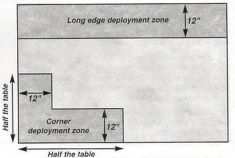
Where 2nd edition uses random asymmetric mission cards 3rd is more scenario driven. The rulebook includes four scenario types each with a selection of missions. Codices often include special missions tailored to that army.
The rulebook also includes advice on designing your own missions and how to run campaigns.
Army Lists
The back of the rulebook includes army lists for Space Marines, Dark Eldar, Tyranids, Imperial Guard, Eldar, Chaos Space Marines, Orks, Sisters of Battle, and Heroes of the Imperium. Some of them have appendices for special units or subfactions like the Space Wolves.
Armies
The game designers had occasionally griped about beardy 2nd edition armies in the magazines. In 3rd edition they set about trying to eliminate them.
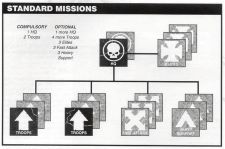
Army building is drastically different. 2nd edition offers relative freedom in choosing armies with three loose categories. 3rd edition has five categories with strict minimums and maximums. Different mission types might require different, sometimes asymmetric, forces which means having to tailor the army to the mission.
The rulebook makes the point that this is primarily to drive the ratio of some unit types to others. You can agree to double the numbers which means a minimum of two HQ units and four troop units.
Wargear options are curtailed for most armies. Many previously legal load-outs are illegal. An Eldar Guardian with lasgun has to count as an Eldar Guardian with shuriken catapult.
The changes did not please the WYSIWYG ↗
players trying to adapt their 2nd edition armies. Efforts were made to reassure players by translating a 2nd edition Blood Angels army (White Dwarf 209's 500pt Force Belisarius) to the new rules.
As you can see, the only real problem is some rejigging of weapons in the Assault squads, because power fists, power swords, power axes etc are limited to use by characters and only one plasma pistol is permitted per squad. However, the 'close combat weapons' category includes swords, chainswords, axes, hand flamers, etc. so most of the weapons carried by the Assault squad can be redefined easily enough.
So the old army does translate into the new - now stop worrying and get fighting!
-Andy Chambers, "Can I Use My Existing Army?", White Dwarf 226
I Blame Gorkamorka!
Out of all the 40K armies I think Orks suffered the most in the transition to the new edition. Many units just vanished and new units appeared made out of whole cloth. I believe Gorkamorka ↗ played a part in this.
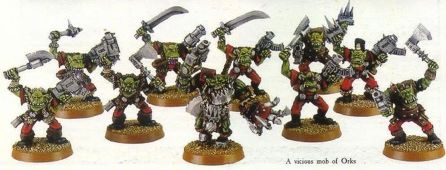
When 3rd edition came out the most recent Ork miniatures ↗ were for the Gorkamorka game. Set on an isolated world, these Orks eschewed the clans that were the mainstay of 40K armies. Gorkamorka initially sold like hotcakes but Games Workshop found themselves overstocked. In 3rd edition Orks received a new range based on the Gorkamorka aesthetic ↗ . I speculate that this was in part to help shift inventory.
The Orks looked more brutal and stripping away all the goofiness did match the general tone of the edition. The new units had specific battlefield roles. Codex Orks came with designer notes.
The Ork trail leads all the way back to the 40K rulebook and the Ork army list in the back of it. In the course of putting together the army lists for 40K we took the opportunity to re-define each of the armies to make them more characterful and a bit more balanced in relation to each other. When I worked on the Ork list I was strongly influenced by my experience of what Ork armies were like when put together using the old Ork Codex. I felt they tended to be very 'bitty', with lots of small mobs from different clans, usually armed to the teeth with meltaguns and plasma guns and hiding behind huge screens of Gretchin cannon-fodder. Close combat was something only indulged in by Boarboyz or occasionally Stormboyz, and most of the damage the army inflicted was by shooting, particularly with a selection of grotesquely effective Squig Katapults, Shokk Attack Gunz and other weirdy weapons.
This didn't seem right to me at all. Orks are supposed to be tough, brutal alien warriors which are always depicted attacking in big, ferocious mobs which threaten to overwhelm the enemy in close combat.
-Andy Chambers, "Gork Told Me To Do It", White Dwarf 235
Waaagh! Grishnak!
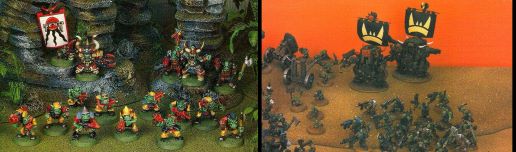
You can see Gorkamorka's influence towards the tail end of 2nd edition. Compare Adie Wood's 1996 40K Ork army in WD201 with his 1998 army in WD222.
Proxies
Our group was always proxying up the wazoo anyway so the main annoyance was that units tended to be bigger. Ten models rather than the five of previous editions.
Squat ↗ players rightfully felt hard done by. They didn't get a codex in 2nd edition and no rules at all in 3rd. An infamous 2004 forum post ↗ claims they were dropped due to a creative disconnect between their Epic and 40K incarnations, among other reasons.
I recommend taking a positive stand by saying "Have you seen these cool old models? They're called the Squats and GW used to make them back in the late eighties/early nineties. I love 'em, so I count them as Imperial Guard and use them with the current rules..." Put like this I can't imagine that anyone would stop you from using your army.
No More Heroes Anymore
The game significantly scales back the effectiveness of individual characters. The instant death rule means characters can be removed from play in one hit. Most org charts limit characters to two per army. Special characters in the codices can only be used with your opponent's permission.
Codices
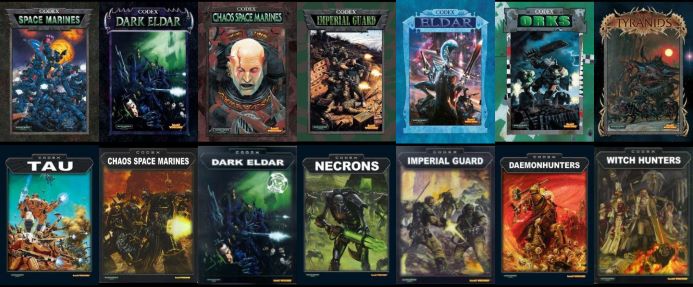
Compared to the 2nd edition, 3rd edition codices are relatively anaemic. Smaller and slimmer, they dropped features standard in 2nd edition. No lengthy histories of the army or detailed descriptions of its members. Battle reports and example armies were out. Later releases are fatter than the early books.
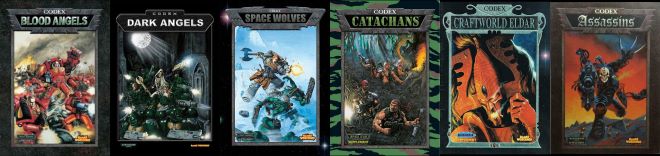
What the 3rd edition codices lack in depth they make up in numbers - over double that of the previous edition. Some books depend on others. Codex Blood Angels is a supplement for Codex Space Marines. Codex Craftworld Eldar is a supplement for Codex Eldar that adds five army list variants for specific Craftworlds. Chaos Space Marines and Imperial Guard each have replacement codices for 3rd.
Necrons, Dark Eldar and Tau became major factions in 3rd edition.
Special Rules
The codices gave most armies a gimmick. Eldar are "Fleet of Foot" giving their light infantry more mobility. Orks have "Mob Rule" which means large units are less likely to flee. And Blood Angels have "Black Rage" which, in addition to close combat bonuses, forces them to move towards the enemy on a D6 of 1. This latter rule is unfortunate for some infantry because heavy weapons are move-or-shoot. Blood Angels also are compelled to lose infantry from squads to form a Death Company at the beginning of the game.
Campaign Codices
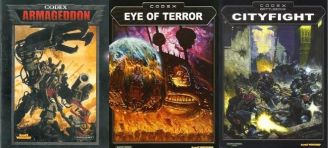
The campaign books Codex Armageddon and Codex Eye of Terror add yet more supplements to existing codices. Games Workshop had previously run popular global campaigns through the pages of White Dwarf. 3rd edition supported a pair of new campaigns with dedicated books.
2000's Codex Armageddon returns to the planet Armageddon, previously the subject of White Dwarf mini-games and a 2nd edition campaign. It includes army supplements to create Ork Speed Freek, Steel Legion Imperial Guard and Black Templar & Salamander Space Marine armies.
2003's Codex Eye of Terror sets the stage for the 13th Black Crusade by the forces of Chaos. It includes army supplements to create Cadian Imperial Guard, Space Wolves 13th Company, Eldar Ulthwe and Lost and the Damned armies.
Cityfight
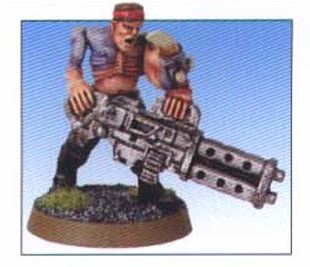
Cityfight contains rules for fighting battles in dense urban locations. This includes rules modifications, special equipment, new scenarios and modelling guides.
Miniatures
All the core armies of the edition - Dark Eldar ↗ / Eldar ↗ / Imperial Guard ↗ / Necrons ↗ / Orks ↗ / Space Marines ↗ / Tau ↗ / Tyranids ↗ - were built around a core of one or more multipart plastic kits supported by pewter model specialists. Everything had access to a variety of plastic vehicle or large monster kits.


White Dwarf (226-296)
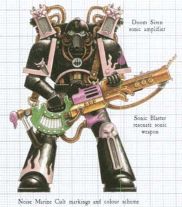
White Dwarf magazine had a relative paucity of "essential" 40K content during 2nd edition. 3rd edition was better served with more original content. Index Astartes ↗ was mostly lore and there was a lot of cool art but occasionally the articles included rules. First founding Space Marine factions without a dedicated codex received army variants. Chapter Approved ↗ included a lot of cool rules.
Most of the rules were centred on force composition. Where Rogue Trader might have an article on a model or unit 3rd edition was all about armies as thematic forces. Occasionally something more in depth was published, like the Feral Orks army list, custom vehicle rules, or alternative assault rules.
White Dwarf also included corrections for the codices.
By Gamers, For Gamers
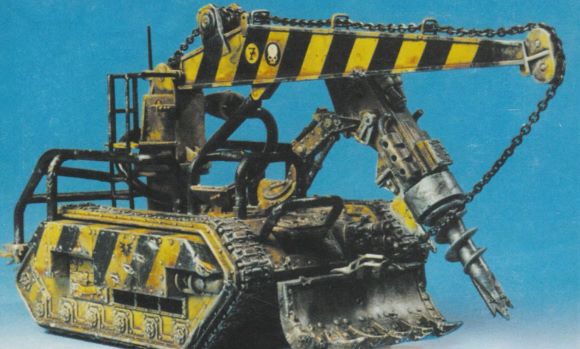
Citadel Journal (CJ27-CJ50) magazine continued to be an outlet for fans to share gaming ideas for 40K. In CJ31 it was announced that it would also be a mechanism for selling Forge World goods. This was Games Workshop's foray into making resin, often parts for converting existing plastic kits. These were sold via Games Workshop's publishing arm ↗
. The magazine published rules for the models.
Revisions
Between the codices, codex supplements, campaign codices, Chapter Approved, Index Astartes and Citadel Journal there were dozens of army lists. Predictably, some were ill-balanced.
Changes to the assault rules were trialled in White Dwarf 273. I don't know which issues of White Dwarf the Vehicle Design Rules and Trial Vehicle Rules were published. All the important errata and trial rules ended up in the Chapter Approved compilations: 2001 ↗ ; 2003 ↗ ; 2004 ↗ .
Beyond 3rd Edition
3rd edition was released in 1998 and supported until the release of 4th edition in 2004. The 4th edition designer's notes in White Dwarf 297 cover 3rd edition's perceived weaknesses.
Negative reactions to 3rd edition must have stung because the game retained the same base ruleset until 2017 and the release of 8th edition. Intervening editions were more refinements than rewrites. Just as well - Dark Eldar weren't to see a new codex until 2010.